Madeline Was Our Sister: Writing, Storytelling, and Truth
By Robert P. Yagelski
Copy edited by Annie Halseth. Designed by Mike Palmquist.
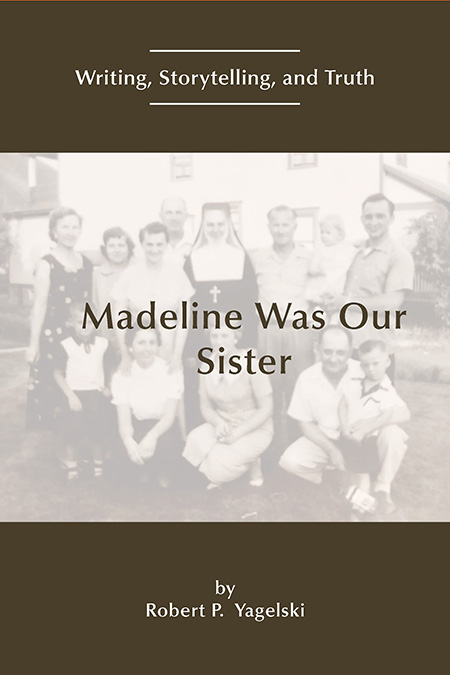 In Madeline Was Our Sister, Robert P. Yagelski explores the related propositions that writing about our experiences in the world can be an essential act of truth-seeking and that truth might reside in the experience of writing-in-the-moment rather than in the text or subject of the writing. A blend of theoretical inquiry, memoir, and narrative, Yagelski focuses on the process of writing a true story about his cousin, whose extraordinary life as a Catholic nun and activist raises complex questions about meaning, identity, family, and faith. That process becomes the vehicle for an extended inquiry into the ontological nature of writing and the relationships among writing, narrative, memory, and truth. In writing a story that encompasses his own evolution as a scholar and writer, Yagelski enacts the argument that the experience of writing-in-the-moment can be a transformative process of identifying the truths we need to make sense of our lives and to live together more humanely in a complicated and often treacherous world. Yagelski demonstrates how writing, as a practice of truth-seeking, can become a tool for living at a time when the very idea of truth is intensely contested. This inquiry has implications not only for how we think about writing as an act of meaning-making and narrative as a vehicle for truth-seeking, but also for longstanding debates about writing instruction, literacy education, schooling, and the never-ending struggle to determine what is true in both our public and private lives.
Table of Contents
Open the entire book: In PDF Format  In ePub Format
Introduction. Writing a True Story of a Life
Chapter 1. The Funeral of a Lifetime: Narrative, Memory, and Purpose in Human Life
Chapter 2. Writing About Experience and the Experience of Writing
Chapter 3. Remembering and Writing a True Story
Chapter 4. A Perfect Story: Writing, Text, and Truth
Chapter 5. Storytelling and Truth-Seeking
Chapter 6. The Ethical and Moral Burden of Writing a True Story
Chapter 7. Writing as a Tool for Living
Afterword. Writing Hope into Being
About the Author
Robert P. Yagelski is Professor Emeritus in the Department of Educational Theory and Practice at the University at Albany (SUNY). He was named the inaugural Dorothy G. Griffin Professor of English Education in 2021, the first endowed professorship in the UAlbany School of Education. He is the author of two scholarly monographs, five college composition textbooks, numerous scholarly articles on writing theory and pedagogy, and a children’s book.
Publication Information: Yagelski, Robert P. (2026). Madeline Was Our Sister: Writing, Storytelling, and Truth. The WAC Clearinghouse; University Press of Colorado. https://doi.org/10.37514/LWR-B.2026.2920
Web Publication Date: March 12, 2026
Print Publication Date: TBD
ISBN: 978-1-64215-292-0 (PDF) | 978-1-64215-293-7 (ePub) | 978-1-64642-925-7 (pbk.)
DOI: 10.37514/LWR-B.2026.2920
Contact Information:
Robert P. Yagelski: ryagelski@albany.edu
Lifespan Writing Research
Series Editors: Ryan Dippre, University of Maine, and Talinn Phillips, Ohio University
This book is available in whole and in part in Adobe's Portable Document Format (PDF). It will also be available in a low-cost print edition from our publishing partner, the University Press of Colorado.
Copyright © 2026 Robert P. Yagelski. This work is licensed under a Creative Commons Attribution-Noncommercial-No Derivative Works 4.0 International License. 218 pages, with notes, illustrations, and bibliographies. This book will be available in print from University Press of Colorado as well as from any online or brick-and-mortar bookstore. Available in digital format for no charge on this page at the WAC Clearinghouse. You may view this book. You may print personal copies of this book. You may link to this page. You may not reproduce this book on another website. For permission requests and other questions, such as creating a translation, please contact the copyright holder.