Writing Centers and AI: Generating Early Conversations
Edited by Elisabeth H. Buck and Joshua Botvin
Copy edited by Sam Maloney. Designed by Mike Palmquist.
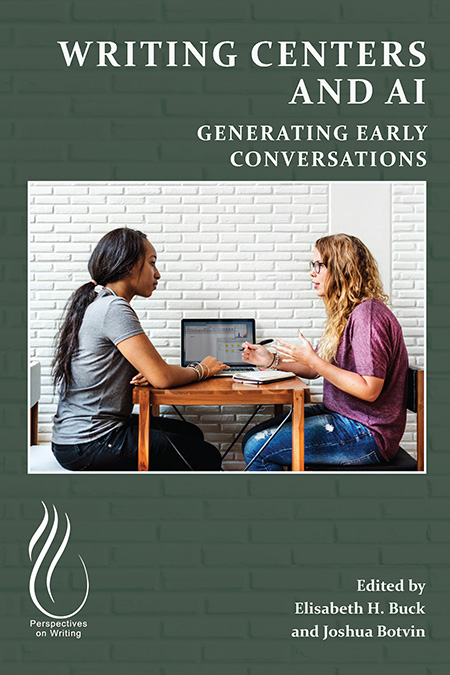 The landscape of higher education has been forever changed by the proliferation of AI-powered large language models. Machine-generated text has provided new opportunities for academic integrity violations, the death of critical thought, and the end to the humanities at large—or, at least, that’s what we’re being told.
The editors and contributors to Writing Centers and AI: Generating Early Conversations—among them writing center tutors and administrators, writing teachers, and disciplinary leaders—posit that writing centers are ideally positioned to assess the remarkable shift in the ways that students are now learning and writing. Drawing on praxis-based, data-driven, and narrative approaches, their 27 chapters explore the intersections of AI and writing center work. The result is a practical guide for writing center practitioners at all levels that addresses the critical role writing centers can and should play in helping students, faculty, and institutions navigate this complicated and historic moment.
Table of Contents
Open the entire book: In PDF Format  In ePub Format
Introduction, Elisabeth H. Buck and Joshua Botvin
DOI: https://doi.org/10.37514/PER-B.2026.2791.1.3
Part 1. Writing Center Professionals as Institutional and Disciplinary Leaders on Conversations about AI
Chapter 1. Centering GenAI: Leading from In-Between Spaces, Sarah Z. Johnson and Sherry Wynn Perdue
DOI: https://doi.org/10.37514/PER-B.2026.2791.2.01
Chapter 2. Lending Our Voices: The Role of Writing Center Leadership in Institutional Conversations about AI, Meghan Velez, Cassandra Branham, Ashley Rea, and Alex Rister
DOI: https://doi.org/10.37514/PER-B.2026.2791.2.02
Chapter 3. Leading the Conversation: Writing Centers as Institutional Leaders on AI, Joseph Cheatle
DOI: https://doi.org/10.37514/PER-B.2026.2791.2.03
Chapter 4. From Margin to Mainstream: Writing Center Voices in GenAI Strategy, Kristi Girdharry
DOI: https://doi.org/10.37514/PER-B.2026.2791.2.04
Chapter 5. Developing AI Policies and Statements: A Reflection on Writing Center/Writing Program Collaboration, Stephanie Hedge and Sarah Collins
DOI: https://doi.org/10.37514/PER-B.2026.2791.2.05
Chapter 6. A Springboard, Not a Landing Zone: Student-First Discussions about AI and Ethics, Joella Cleary and Anna Rymer
DOI: https://doi.org/10.37514/PER-B.2026.2791.2.06
Part 2. Researched Inquiries on AI and Writing Center Labor
Chapter 7. “ChatGPT is good at some stuff … but it’s not like it’s a person”: Student Writers Reflect on AI, Rebecca Hallman Martini
DOI: https://doi.org/10.37514/PER-B.2026.2791.2.07
Chapter 8. Understanding the Landscape of Generative AI Use among Writing Center Clients, Julia Bleakney, Lauren Jablon, and Paula Rosinski
DOI: https://doi.org/10.37514/PER-B.2026.2791.2.08
Chapter 9. “I Needed Help”: Generative AI as Writing Tutor, Matthew Fledderjohann and Emily C. Perkins
DOI: https://doi.org/10.37514/PER-B.2026.2791.2.09
Chapter 10. Research-Based Guidelines for Building More Targeted Writing Center Actions: Faculty and Student Views on AI for Academic Writing, Hamza Miftah, Dacia Dressen-Hammouda, and Christine Blanchard
DOI: https://doi.org/10.37514/PER-B.2026.2791.2.10
Chapter 11. Conversing with the Past: How Previous Research Can Guide Approaches to Generative Artificial Intelligence in Writing Centers, Jean Schwab
DOI: https://doi.org/10.37514/PER-B.2026.2791.2.10
Chapter 12. The Machine Genie: Instructional Metaphors for LLM Text Production, Rodolfo Barrett
DOI: https://doi.org/10.37514/PER-B.2026.2791.2.12
Part 3. Developing Training Materials and Praxis in Response to AI
Chapter 13. Into the (Un)Known: Using Academic Habits of Mind to Address Generative Artificial Intelligence Concerns and Possibilities in Tutor Trainingm, Kat Greene and Charlotte Kupsh
DOI: https://doi.org/10.37514/PER-B.2026.2791.2.13
Chapter 14. What Is Our Writing Center’s Stance on AI? Using Tutor Training to Develop Guidelines and Learn about GenAI, Ashley M. Beardsley
DOI: https://doi.org/10.37514/PER-B.2026.2791.2.14
Chapter 15. Re(de)fining Collaboration: Leveraging AI’s Potentials in Asynchronous Writing Center Sessions and Tutor Training, Amanda M. May
DOI: https://doi.org/10.37514/PER-B.2026.2791.2.15
Chapter 16. Reinventing a New Vision and Raison d’Être: Holistic Writing Center Community of Practice Framework, Helen Lepp Friesen and Eunhee Buettner
DOI: https://doi.org/10.37514/PER-B.2026.2791.2.16
Chapter 17. Centering the Human: A Tutor Training Approach to AI-Generated Writing Technology, Ellen Cecil-Lemkin and Lisa Marvel Johnson
DOI: https://doi.org/10.37514/PER-B.2026.2791.2.17
Part 4. Practices for Navigating AI with/in Writing Center Consultations
Chapter 18. Countering AI Shame in the Writing Center: Cultivating Tutoring Practices of Openness and Vulnerability, James M. Cochran, Kathryn Pilliod, and Madilynne Smith
DOI: https://doi.org/10.37514/PER-B.2026.2791.2.18
Chapter 19. Embracing AI as a “Second Reader” in Writing Center Consultations: Exploring New Opportunities for Learning and Reflection, Chloe Crull and Nicholas Stillman
DOI: https://doi.org/10.37514/PER-B.2026.2791.2.19
Chapter 20. LLMs Generate Answers, Writing Tutors Ask Questions: GenAI as Sites of Transfer for Writing Center Practice, Deirdre Vinyard and Carly Schnitzler
DOI: https://doi.org/10.37514/PER-B.2026.2791.2.20
Chapter 21. Looping Generative AI into Writing Center Consultations, Eric Mason and Kevin Dvorak
DOI: https://doi.org/10.37514/PER-B.2026.2791.2.21
Chapter 22. De-Centering GenAI Outputs and Re-Centering Student Labor, Kirkwood Adams and Maria Baker
DOI: https://doi.org/10.37514/PER-B.2026.2791.2.22
Part 5. Writing Centers’ Role in Fostering Accessible, Anti-Racist, and Ethical AI Practices
Chapter 23. HBCU Writing Centers Confronting the “Canonized Corpus”, Austin Anderson, Sabrina Bramwell, Alexandra Omogbadegun, and Paola Yuli
DOI: https://doi.org/10.37514/PER-B.2026.2791.2.23
Chapter 24. Disrupting the Writing Process: How Generative AI Helps Students with Disabilities Communicate, Cara Violini
DOI: https://doi.org/10.37514/PER-B.2026.2791.2.24
Chapter 25. Recentering Writing Centers to Address the Hidden GenAI Curriculum, Joni Hayward Marcum and Lisa Bell
DOI: https://doi.org/10.37514/PER-B.2026.2791.2.25
Chapter 26. Reclaiming Agency: AI Hallucinations and Translingual Interrogations in the City Tech Writing Center, Joseph Franklin and Anna Laura Falvey
DOI: https://doi.org/10.37514/PER-B.2026.2791.2.26
Chapter 27. “How Do We Stop Students from Using AI?” Writing Centers, Generative AI, and Linguistic Justice, Joshua Botvin
DOI: https://doi.org/10.37514/PER-B.2026.2791.2.27
About the Editors
Elisabeth H. Buck is Associate Professor of English and Director of the Writing Center at Fordham University in New York City. She is the author of Open-Access, Multimodality, and Writing Center Studies (Palgrave, 2018), which was a finalist for the 2018 IWCA Outstanding Book Award. Her work has appeared in multiple journals and collections across writing studies, and she is the current editor of The Peer Review journal. She enjoys researching and teaching writing center theory and administration, digital and social media, and the rhetoric of popular culture.
Joshua Botvin is Assistant Teaching Professor in the English and Communication Program and the Assistant Director of the Writing and Multiliteracy Center at the University of Massachusetts Dartmouth. He is also a doctoral atudent in the Technical Communication and Rhetoric program at Texas Tech University. He instructs first-year courses in Critical Writing & Reading as well as Technical and Business Communication. His research interests focus on the studies of rhetoric, writing centers, generative AI, labor equity, and classroom accessibility.
Publication Information: Buck, Elisabeth H., & Joshua Botvin (Eds.). (2026). Writing Centers and AI: Generating Early Conversations. The WAC Clearinghouse; University Press of Colorado. https://doi.org/10.37514/PER-B.2026.2791
Web Publication Date: March 18, 2026
Print Publication Date: TBD
ISBN: 978-1-64215-279-1 (PDF) 978-1-64215-280-7 (ePub) 978-1-64642-869-4 (pbk.)
DOI: 10.37514/PER-B.2026.2791
Contact Information:
Elisabeth H. Buck: ebuck7@fordham.edu
Joshua Botvin: jbotvin@umassd.edu
Perspectives on Writing
Series Editors: Rich Rice, Texas Tech University, and J. Michael Rifenburg, University of North Georgia
This book is available in whole and in part in Adobe's Portable Document Format (PDF). It will also be available in a low-cost print edition from our publishing partner, the University Press of Colorado.
Copyright © 2026 Elisabeth H. Buck and Joshua Botvin and the authors of individual parts of this book. This work is licensed under a Creative Commons Attribution-Noncommercial-No Derivative Works 4.0 International License. 358 pages, with notes, figures, and bibliographies. This book will be available in print from University Press of Colorado as well as from any online or brick-and-mortar bookstore. Available in digital format for no charge on this page at the WAC Clearinghouse. You may view this book. You may print personal copies of this book. You may link to this page. You may not reproduce this book on another website. For permission requests and other questions, such as creating a translation, please contact the copyright holder.