Storied Practices: Positionality in Writing Studies
Edited by Kristine Acosta, Michelle Cowan, Rebecca Rickly, Nancy Small, and Erica M. Stone
Copyedited and designed by Mike Palmquist.
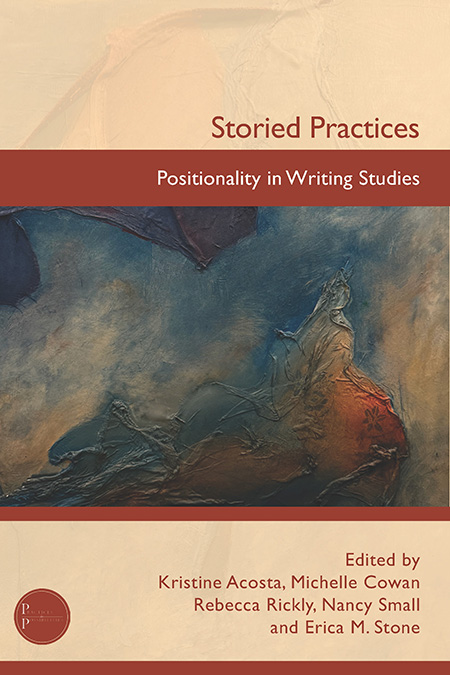 The contributors to Storied Practices: Positionality in Writing Studies explore how the various identities and lived experiences of scholars shape their professional personas, research methodologies, and teaching practices. The chapters in this edited collection employ reflexivity and storytelling in ways that can help emerging and experienced scholar-teachers rethink their conception of academic work. The result is a book that serves as an intersection point from which more scholarship about positionality can grow.
Table of Contents
Open the entire book: In PDF Format  In ePub Format
Introduction, Kristine Acosta, Michelle Cowan, Rebecca Rickly, Nancy Small, and Erica M. Stone
DOI: 10.37514/PRA-B.2026.2906.3.1
Section 1. Community Engagement, Writing, Research
Chapter 1. Positionality Pulls up a Chair at the Kitchen Table, Lisa L. Phillips
DOI: 10.37514/PRA-B.2026.2906.2.01
Chapter 2. Flattening Hierarchies in Community-Engaged Writing Studies Research, Gabrielle Isabel Kelenyi, Marisol Gonzalez, and Tiffani Puccio
DOI: 10.37514/PRA-B.2026.2906.2.02
Chapter 3. Re-Living the Stories of Black Women and Girls from a Historic Black Town in Alabama, Margaret Holloway
DOI: 10.37514/PRA-B.2026.2906.2.03
Chapter 4. Storied Practices in Community-Engaged Work: Expanding Conceptions of Positionality, Ann Blakeslee and Michele Simmons
DOI: 10.37514/PRA-B.2026.2906.2.04
Chapter 5. My Research Ethics, Myself: Reflecting on Feminist Research Regrets, Jamie White-Farnham
DOI: 10.37514/PRA-B.2026.2906.2.05
Section 2. Collaborations
Chapter 6. El Poder de la Amistad: Leaning into Friendship During Shifts in Positionality, Kristine Acosta
DOI: 10.37514/PRA-B.2026.2906.2.06
Chapter 7. Positionality in Crafting Memoirs: Author-Editor Collaboration, Rebecca E. Burnett and William L. Jeffries
DOI: 10.37514/PRA-B.2026.2906.2.07
Chapter 8. Writing My Way into Belonging: Negotiating Positionality and Exposure in Rhetoric and Writing Scholarship, Letizia Guglielmo
DOI: 10.37514/PRA-B.2026.2906.2.08
Chapter 9. A Dialog on Positionality, Mentoring, and Impermanence, Ritika Popli and Meg Worley
DOI: 10.37514/PRA-B.2026.2906.2.09
Chapter 10. Pitch Mode: Acquiring Reflexivity in Scholarly Journal Editing, Christopher D. M. Andrews
DOI: 10.37514/PRA-B.2026.2906.2.10
Section 3. Between Disciplines
Chapter 11. “Quadeesh hathi?”: Negotiating Positionality as a Transnational Filmmaker, Kefaya Diab
DOI: 10.37514/PRA-B.2026.2906.2.11
Chapter 12. Networking the Self and Subjects through Writing, Liane Malinowski
DOI: 10.37514/PRA-B.2026.2906.2.12
Chapter 13. Between the Camera and the Self: Positionality and Reflexivity as a Scholar-Maker, Margaret Baker Ndwandwe
DOI: 10.37514/PRA-B.2026.2906.2.13
Section 4. Dissertation Writing
Chapter 14. Positions of Change: How a Coupled Collaboration Disrupted the Dissertation System, Laura Mangini and Sabatino Mangini
DOI: 10.37514/PRA-B.2026.2906.2.14
Chapter 15. From Positionality Statement to Motivating Positionality Story, Keira Hambrick
DOI: 10.37514/PRA-B.2026.2906.2.15
Chapter 16. I Feel You: A Shared User eXperience as a Racial Storytelling of Positionality, Jerrice Renita Donelson
DOI: 10.37514/PRA-B.2026.2906.2.16
Chapter 17. Navigating Formality and Familiarity: Balancing Research and Relationships in Your Own Community, Nattaporn Luangpipat
DOI: 10.37514/PRA-B.2026.2906.2.17
Chapter 18. Voicing Resilience: A Written Journey Through Infertility and IVF, Daniela Merlos
DOI: 10.37514/PRA-B.2026.2906.2.18
Section 5. Teacher Practice
Chapter 19. Taking Up Space to Take a Position, Sarah Young
DOI: 10.37514/PRA-B.2026.2906.2.19
Chapter 20. Confessions of a Full-time Professor/Part-time Researcher, Jessica Lipsey
DOI: 10.37514/PRA-B.2026.2906.2.10
Chapter 21. Who Tells Your Story: The Power of Counterstory and Conversations of Positionality in First-Year Writing, Cyndy Lopez Guerrero
DOI: 10.37514/PRA-B.2026.2906.2.21
Chapter 22. When Writing Hurts: Positionality, Recovery, and Distance When Forming and Maintaining a Research Identity, Kathleen Sandell Hardesty and Leah Heilig
DOI: 10.37514/PRA-B.2026.2906.2.22
Chapter 23. What Is She Doing Here? , Jessica Batychenko
DOI: 10.37514/PRA-B.2026.2906.2.23
Section 6. Insider/Outsider
Chapter 24. Balancing an Insider and Outsider Perspective: Positionality as a Practice of Mindfulness, Elizabeth Hurst Marold
DOI: 10.37514/PRA-B.2026.2906.2.24
Chapter 25. The Dynamics of Experiencing Multiple Positionalities in Qualitative Research: Reflecting on Relationships with Research Participants, Kristin D. Pickering
DOI: 10.37514/PRA-B.2026.2906.2.25
Chapter 26. Neighbor or Researcher? Fluid Positionality in Community-Engaged Research, Ania Payne
DOI: 10.37514/PRA-B.2026.2906.2.26
Chapter 27. “I Believe in the Future of Agriculture . . . and Composition”: Abiding in Positional Differences through Educating Rural Students, Hanna Sanders
DOI: 10.37514/PRA-B.2026.2906.2.27
Chapter 28. Living Adjacent and Approaching Askew: Pathways for Building a Research Agenda, Lynée Lewis Gaillet
DOI: 10.37514/PRA-B.2026.2906.2.28
Section 7. Marginalized Perspectives
Chapter 29. Embracing Tensions in Critical Qualitative Research: Letters from a Friend, Ana Isabel Terminel Iberri
DOI: 10.37514/PRA-B.2026.2906.2.29
Chapter 30. Beyond the Headlines: A Muslim Professor in the USA, Mohamed Yacoub
DOI: 10.37514/PRA-B.2026.2906.2.30
Chapter 31. Caught in Between: A View of Positionality and Marginalization from the Middle, Rosanna M. Vail
DOI: 10.37514/PRA-B.2026.2906.2.31
Chapter 32. Seeking the “Self” in Relation to “Others”: Negotiating with Multiple Selves of an IPV Researcher, Pooja Ichplani
DOI: 10.37514/PRA-B.2026.2906.2.32
Section 8. Bridging Cultures
Chapter 33. Interpositionality of Emotionality: How My Monolingual Taiwanese Nationality Intersects with Dual Citizenship of Taiwanese Americanness, Meng-Hsien Neal Liu
DOI: 10.37514/PRA-B.2026.2906.2.33
Chapter 34. Reckoning The Privilege of White Multilingualism, Analeigh E. Horton
DOI: 10.37514/PRA-B.2026.2906.2.34
Chapter 35. Positioning Our Shared-Leadership Research and Practice: Multivoicing Our Multiculture of Writing at an Historically Hispanic-Serving Institution, Steven J. Corbett, Shelby Coalson, Annette Vara, Elsa Angelica Alvarez, Alyssa Morales, Larisa Garcia, and Casidy Leal
DOI: 10.37514/PRA-B.2026.2906.2.35
Chapter 36. Positionality as a Simulacrum, Shiva Mainaly
DOI: 10.37514/PRA-B.2026.2906.2.36
Chapter 37. A Tale of Two Democracies: Writing Studies Between the US and India, Durba Chattaraj
DOI: 10.37514/PRA-B.2026.2906.2.37
Section 9. Embodiment
Chapter 38. Disclosing Eating Disorder Recovery: The Pursuit of Credibility and the Pressure of Representation, Michelle Cowan
DOI: 10.37514/PRA-B.2026.2906.2.38
Chapter 39. (Dis)Association—Writing and Reclaiming Agency Through Feminist Solidarity, Ana Julia Eriquezzo
DOI: 10.37514/PRA-B.2026.2906.2.39
Chapter 40. When Your Work Is Good, but It's Not Good for You: Navigating Career Pivots, Liz Angeli
DOI: 10.37514/PRA-B.2026.2906.2.40
Chapter 41. The Autistic Me and Advocacy Research for Neurodiverse Writers, C. Scott Wyatt
DOI: 10.37514/PRA-B.2026.2906.2.41
Chapter 42. Evolution of Positionality: A Personal Journey Towards Social Justice in Research and Teaching, Hua Wang
DOI: 10.37514/PRA-B.2026.2906.2.42
Section 10. Queering Binaries
Chapter 43. A Case for Causing a Little Trouble: Developing Queer Positionality Through Disciplinary Homemaking, Molly Ryan
DOI: 10.37514/PRA-B.2026.2906.2.43
Chapter 44. Bisexual Research Frameworks: Navigating Insider-Outsider Identities of Power, Beth Buyserie
DOI: 10.37514/PRA-B.2026.2906.2.44
Chapter 45. A Queer Perspective on Teaching Positionality and Objectivity in Journalistic Writing, Bobbie Foster
DOI: 10.37514/PRA-B.2026.2906.2.45
Section 11. Tensions of Disclosure
Chapter 46. Privileged Entanglements, Joshua Barsczewski and Timothy Oleksiak
DOI: 10.37514/PRA-B.2026.2906.2.46
Chapter 47. Stories from the Field: When Worlds Collide and the Research Hits Close to Home, Callie F. Kostelich
DOI: 10.37514/PRA-B.2026.2906.2.47
Chapter 48. Learning How Much to Say and Troubling Positionality as a Form of Disclosure, Jennifer Burke Reifman
DOI: 10.37514/PRA-B.2026.2906.2.48
Section 12. Troubled Times
Chapter 49. Debunking the Flunking-Forward Myth: Towards Position-based Failure Narratives, Wally Suphap
DOI: 10.37514/PRA-B.2026.2906.2.49
Chapter 50. Flailings and Failings: Managing Emotions and Balancing Perspectives as an Emerging Researcher, Megan Heise
DOI: 10.37514/PRA-B.2026.2906.2.50
Chapter 51. Yes, and: Reckoning with Positionality in the Academic Workplace, Jenn Fishman
DOI: 10.37514/PRA-B.2026.2906.2.51
Chapter 52. Multiracial Rhetorics of Representation: Enduring Ecologies and Destabilizing Ideas of Positionality, Gina Atkins
DOI: 10.37514/PRA-B.2026.2906.2.52
Section 13. Pedagogy
Chapter 53. “Reflexivity Memos” in Undergraduate Research-Based Writing: Opening Spaces to Value Students' Experiences and Stories in Research, Jennifer Johnson
DOI: 10.37514/PRA-B.2026.2906.2.53
Chapter 54. Teaching Tolerance, Teaching Positionality, Mariana Grohowski
DOI: 10.37514/PRA-B.2026.2906.2.54
About the Editors
Kristine Acosta is Assistant Teaching Professor of Writing and Rhetoric and the Student Success Coordinator for the English Department at Florida International University. Her research centers around how technical communication and rhetoric impact communities. Much of her work focuses on the importance of storytelling and positionality in research. She is particularly interested in community writing, Cuban-American studies, and the Latine experience. As a teacher of professional and technical writing, Kristine is passionate about using rhetoric, writing, and intercultural communication to help advance community literacy in today's world.
Michelle Cowan is Assistant Professor of Business Administration at Washington and Lee University, where she teaches business communication and multimedia design. Her research focuses on rhetorics of health and medicine, corporate care discourse, and assessment practices in the workplace and the classroom.
Rebecca J. Rickly is Professor Emeritus of Rhetoric and Technical Communication at Texas Tech University. At TTU she taught courses in research methods, writing for publication, rhetoric, and style. Her publications include The Online Writing Classroom and Performing Feminism and Administration in Rhetoric and Composition Studies as well as articles, special issues, and book chapters. Now she spends her time enjoying central Texas hill country, tending to the land, and riding her lovely horses: Paddy 2.0, Crunchie, and Noa.
Nancy Small is Associate Professor of English at the University of Wyoming. Her primary research focus is the rhetorical structures and power of everyday storytelling and narrative across a wide variety of forms. Her first monograph, A Rhetoric of Becoming: USAmerican Women in Qatar, demonstrates the emergence of a complicated community lifeworld formed through the sharing of lived experiences. She has also published articles, chapters, and an edited collection demonstrating how stories about the research process yield insights into more ethical practices. She is currently working on a second monograph that uses a braided rhetorical approach to consider the lives of women in the American West.
Erica M. Stone (she/her) is a content designer and researcher with experience in both academia and industry. She works at the intersection of technical communication, public rhetoric, and community organizing. Erica's writing can be found in Journal of Technical Writing & Communication; Technical Communication; Writing Program Administration; Kairos: A Journal of Rhetoric, Technology, and Pedagogy; Forum: Issues about Part-time & Contingent Faculty; Basic Writing Electronic (BWe) Journal; Spark: A 4C4Equality Journal; Community Literacy Journal; and various edited collections. She can be reached via email at erica.m.stone@gmail.com.
Publication Information: Acosta, Kristine, Michelle Cowan, Rebecca Rickly, Nancy Small, & Erica M. Stone. (2026). Storied Practices: Positionality in Writing Studies. The WAC Clearinghouse; University Press of Colorado. https://doi.org/1010.37514/PRA-B.2026.2906
Digital Publication Date: March 19, 2026
Print Publication Date: TBD
ISBN: 978-1-64215-290-6 (PDF) | 978-1-64215-291-3 (ePub) | 978-1-64642-924-0 (pbk.)
DOI: 10.37514/PRA-B.2026.2906
Contact Information:
Kristine Acosta: kristinef.acosta@gmail.com
Michelle Cowan: mcowan@wlu.edu
Rebecca J. Rickly: rebecca.rickly@gmail.com
Nancy Small: nancy.small@uwyo.edu
Erica M. Stone: erica.m.stone@gmail.com
Practices & Possibilities
Series Editors: Aimee McClure, Clarke University; Aleashia Walton, University of Cincinnati; Jagadish Paudel, Clemson University; and Mike Palmquist, Colorado State University
This book is available in whole and in part in Adobe's Portable Document Format (PDF). It will also be available in a low-cost print edition from our publishing partner, the University Press of Colorado.
Copyright © 2026 Kristine Acosta, Michelle Cowan, Rebecca Rickly, Nancy Small, and Erica M. Stone and the contributors to individual parts of this book. This work is licensed under a Creative Commons Attribution-Noncommercial-No Derivative Works 4.0 International License. 334 pages, with notes, illustrations, and bibliography. This book will be available in print from University Press of Colorado as well as from any online or brick-and-mortar bookstore. Available in digital formats for no charge on this page at the WAC Clearinghouse. You may view this book. You may print personal copies of this book. You may link to this page. You may not reproduce this book on another website. For permission requests and other questions, such as creating a translation, please contact the copyright holders.