Approaches to Lifespan Writing Research: Generating an Actionable Coherence
- Lifespan writing, identity, writing studies, Society, Culture, Linguistics
Edited by Ryan J. Dippre and Talinn Phillips
Copy edited by Don Donahue. Designed by Mike Palmquist.
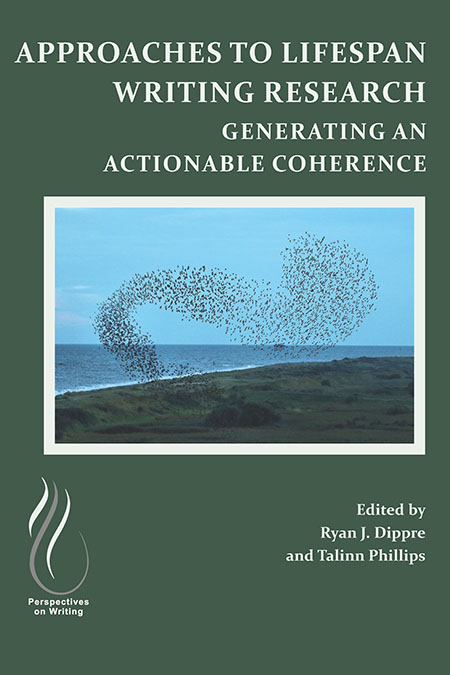 This edited collection builds on the three themes that emerged from the 2018 inaugural lifespan writing conference—identity, society, and theory—to further the study of writing through the lifespan. The contributors to this collection provide a framework within which the reader can develop a dynamic, interdisciplinary, multifaceted understanding of the limits and possibilities of studying lifespan writing. Recognizing that such research requires methodological rigor and flexibility as well as theoretical precision and adaptability, Approaches to Lifespan Writing Research draws on a range of methodological and theoretical approaches, from autoethnography to longitudinal structural equation modeling. This methodological and theoretical flexibility reflects the challenges inherent in studying lifespan writing—in particular, the need to develop an integrated framework that enables the “translation” of research findings for use by other lifespan writing researchers. Approaches to Lifespan Writing Research begins that process.
Table of Contents
Open the entire book: In PDF Format  In ePub Format
Preface, Charles Bazerman
DOI: https://doi.org/10.37514/PER-B.2020.1053.1.1
Introduction. Generating Murmurations for an Actionable Coherence, Ryan J. Dippre and Talinn Phillips
DOI: https://doi.org/10.37514/PER-B.2020.1053.1.3
Chapter 1. Across, Through, and With: Ontological Orientations for Lifespan Writing Research, Anna Smith
DOI: https://doi.org/10.37514/PER-B.2020.1053.2.01
Chapter 2. Always Already Relocalized: The Protean Nature of Context in Lifespan Writing Research, Ryan J. Dippre and Anna Smith
DOI: https://doi.org/10.37514/PER-B.2020.1053.2.02
Chapter 3. Quantitative Perspectives to the Study of Writing Across the Lifespan: A Conceptual Overview and Focus on Structural Equation Modeling, Matthew C. Zajic and Apryl L. Poch
DOI: https://doi.org/10.37514/PER-B.2020.1053.2.03
Chapter 4. Making Sense of a Person’s Literate Life: Literacy Narratives in a 100-Year-Study on Literacy Development, Magdalena Knappik
DOI: https://doi.org/10.37514/PER-B.2020.1053.2.04
Chapter 5. A Definition of Everyday Writing: Methods for a Writer-Informed Approach to Lifespan Writing, Jeff Naftzinger
DOI: https://doi.org/10.37514/PER-B.2020.1053.2.05
Chapter 6. Revisiting Participants After Publication: Continuing Writing Partnerships, Lauren Rosenberg
DOI: https://doi.org/10.37514/PER-B.2020.1053.2.06
Part 2. Leveraging Our Traditions
Chapter 7. Literacy Tours and Material Matters: Principles for Studying the Literate Lives of Older Adults, Lauren Marshall Bowen
DOI: https://doi.org/10.37514/PER-B.2020.1053.2.07
Chapter 8. Toward an Understanding of the Multidirectional Nature of Family Literacy Development, Yvonne Lee
DOI: https://doi.org/10.37514/PER-B.2020.1053.2.08
Chapter 9. Writing as a Matter of Life and Death: Writing Through the Transition Between Employment and Retirement in the USA, James T. Zebroski
DOI: https://doi.org/10.37514/PER-B.2020.1053.2.09
Chapter 10. The Relations Among the Development of Written Language and Executive Functions for Children in Elementary School, Lara-Jeane C. Costa, Jeffrey A. Greene, and Stephen R. Hooper
DOI: https://doi.org/10.37514/PER-B.2020.1053.2.10
Chapter 11. Interpreting and Explaining Data Representations: A Comparison Across Grades 1-7, Diana J. Arya, Anthony Clairmont, and Sarah Hirsch
DOI: https://doi.org/10.37514/PER-B.2020.1053.2.11
Chapter 12. Informing Inquiry into Writing Across the Lifespan from Perspectives on Students with Learning Disabilities or Autism Spectrum Disorder, Apryl L. Poch, Matthew C. Zajic, and Steve Graham
DOI: https://doi.org/10.37514/PER-B.2020.1053.2.12
Chapter 13. Visualizing Writing Development: Mapping Writers’ Conceptions of Writing through the Lifespan, Erin Workman
DOI: https://doi.org/10.37514/PER-B.2020.1053.2.13
Chapter 14. Addressing the Futurity of Literate Action: Tracing the Enduring Consequences of Acting with Inscriptions throughout the Lifeworld, Kevin Roozen
DOI: https://doi.org/10.37514/PER-B.2020.1053.2.14
Conclusion as Prolegomena: From Points of Convergence to Murmurations across Sites, Researchers, and Methods, Ryan J. Dippre and Talinn Phillips
DOI: https://doi.org/10.37514/PER-B.2020.1053.3.1
Epilogue, Deborah Brandt
DOI: https://doi.org/10.37514/PER-B.2020.1053.3.2
About the Editors
Ryan J. Dippre is Assistant Professor of English and the Director of College Composition at the University of Maine. He earned his Ph.D. from University of California, Santa Barbara in 2015. He has published in Literacy in Composition Studies and English Journal, among other places. His book, Talk, Tools, and Texts: A Logic-in-Use for Studying Lifespan Literate Action Development, is available at the WAC Clearinghouse / University Press of Colorado. He serves as the co-chair of the Writing through the Lifespan Collaboration, a group of international scholars interested in developing a multi-site, multi-method, multi-generational study of writing through the lifespan. His research interests include lifespan writing research and writing program administration.
Talinn Phillips is Associate Professor of English at Ohio University where she also directs the Graduate Writing and Research Center. In addition to the lifespan, her research has investigated international graduate student writing development, liminal writing program administrators, and various intersections of graduate students and writing center support. She is co-editor of Supporting Graduate Student Writers: Research, Curriculum, and Program Design (University of Michigan Press, 2016), co-author of Teaching with a Global Perspective: Practical Strategies from Course Design to Assessment (Routledge, 2018), and co-creator of the tutor training film, Becoming an Ally: Tutoring Multilingual Writers (2017). She is a co-founder of the Writing Through the Lifespan Collaboration.
Publication Information: Dippre, Ryan J., & Talinn Phillips (Eds.). (2020). Approaches to Lifespan Writing Research: Generating an Actionable Coherence. The WAC Clearinghouse; University Press of Colorado. https://doi.org/10.37514/PER-B.2020.1053
Web Publication Date: August 15, 2020
Print Publication Date: January 2021
ISBN: 978-1-64215-105-3 (PDF) | 978-1-64215-106-0 (ePub) | 978-1-64642-145-9 (pbk.)
DOI: 10.37514/PER-B.2020.1053
Contact Information:
Ryan J. Dippre: ryan.dippre@maine.edu
Talinn Phillips: tiller@ohio.edu
Perspectives on Writing
Series Editors: Rich Rice, Texas Tech University; Heather MacNeill Falconer, Curry College; and J. Michael Rifenburg, University of North Georgia
This book is available in whole and in part in Adobe's Portable Document Format (PDF). It is also available in a low-cost print edition from our publishing partner, the University Press of Colorado.
Copyright © 2020 Ryan J. Dippre, Talinn Phillips and the authors of individual parts of this book. This work is licensed under a Creative Commons Attribution-Noncommercial-No Derivative Works 4.0 International License. 282 pages, with notes, illustrations, and bibliographies. This book is available in print from University Press of Colorado as well as from any online or brick-and-mortar bookstore. Available in digital format for no charge on this page at the WAC Clearinghouse. You may view this book. You may print personal copies of this book. You may link to this page. You may not reproduce this book on another website. For permission requests and other questions, such as creating a translation, please contact the copyright holder.