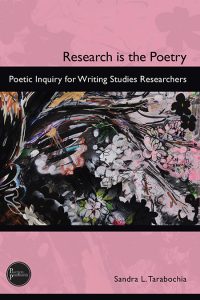
Research is the Poetry: Poetic Inquiry for Writing Studies Researchers
By Sandra L. Tarabochia
Copy edited by Karen Peirce. Designed by Mike Palmquist.
In Research is the Poetry, Sandra L. Tarabochia demonstrates the promise of poetic inquiry, the arts-based method of creating poems with, as, and in relation to qualitative research data. Informed by studies from a range of disciplines, each chapter introduces a particular poetic research practice and features dynamic examples from Tarabochia’s eight-year longitudinal study of faculty writing lives. Thorough discussion of the affordances and challenges of each approach and guiding questions for reflection prompt readers to imagine when, why, and how they might practice poetic inquiry in their own research contexts. Candidly sharing her own process of discovering and learning the method, Tarabochia makes a compelling case for poetic inquiry as a form of methodological surrender, a way of loosening our grip on certainty and what we think we know about scholarly meaning making. Research is the Poetry shows writing researchers how to tap into the human dimensions of our work and begin to know, be, and do differently.
Sandra L. Tarabochia is Associate Professor of English at the University of Oklahoma, where she serves as Director of Rhetoric & Writing Studies. Her book Reframing the Relational: A Pedagogical Ethic for Cross-Curricular Literacy Work is part of the CCCC/NCTE series Studies in Writing and Rhetoric. She has published scholarship in Peitho, Written Communication, Composition Studies, and Writing & Pedagogy. She a founding co-editor (with Aja Y. Martinez and Michele Eodice) of the open-access journal Writers: Craft & Context.
Publication Information:
Tarabochia, Sandra L. (2026). Research is the Poetry: Poetic Inquiry for Writing Studies Researchers. The WAC Clearinghouse; University Press of Colorado. https://doi.org/1010.37514/PRA-B.2026.2968
Series Editors: Aimee McClure, Clarke University; Aleashia Walton, University of Cincinnati; Jagadish Paudel, Clemson University; and Mike Palmquist, Colorado State University
This book is available in whole and in part in Adobe’s Portable Document Format (PDF). It will also be available in a low-cost print edition from our publishing partner, the University Press of Colorado .
Financial support for the development and publication of this book was provided from the Dodge Family College of Arts and Sciences, Office of the Vice President for Research and Partnerships, and University Libraries, University of Oklahoma.