The Proceedings of the Computers and Writing Conference, 2025

The 2025 Computers & Writing Conference was hosted by the University of Georgia from Thursday, May 15th to Sunday, May 18th, 2025. The theme for the conference was Agency and Authorship. In their call for proposals, the organizers observed, “The 2025 conference will emphasize place and how specific locales work with digital technologies to provide platforms for expressions of agency borne out of lived, place-based experience. Such consideration for the relationships between place, writing, and the digital world call us to reconsider what it means to come together for this conference in a particular place.”
The Proceedings
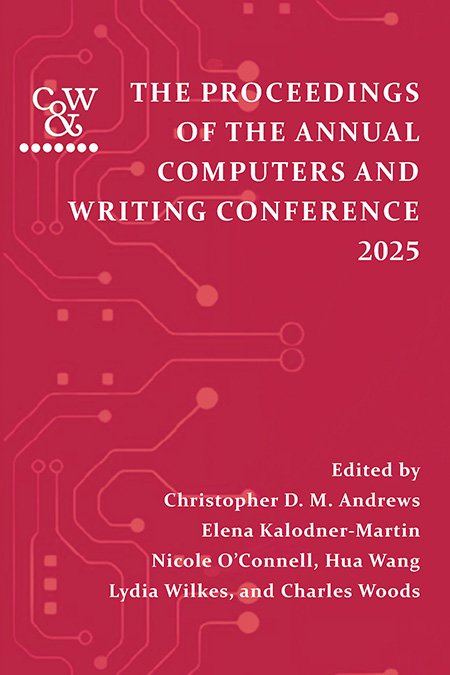
Edited by Christopher D. M. Andrews, Elena Kalodner-Martin, Nicole O’Connell, Hua Wang, Lydia Wilkes, and Charles Woods
Copy edited by Christopher D. M. Andrews, Brandy Dieterle, Nicole O’Connell, Elena Kalodner-Martin, and Hua Wang. Designed by Mike Palmquist.
This edited collection includes selected proceedings from the 2025 Computers and Writing Conference. Contributions engage with the 2025 conference theme, Agency and Authorship, using a variety of theoretical, pedagogical, and research-based approaches familiar to scholars of digital rhetorics, multimodal composition, and closely related fields.
Open the entire book: In PDF Format  In ePub Format
Introduction (or Speaking of Generative AI ...), Christopher D. M. Andrews, Elena Kalodner-Martin, Nicole O’Connell, Hua Wang, Lydia Wilkes, and Charles Woods
What’s “Critical” about “Critical AI”? A Recommitment to Humanistic Inquiry in the Ostensible March to Hyper-Automation, Jennifer
Sano-Franchini
DOI: https://doi.org/10.37514/PCW-B.2026.2883.2.01
The Rhetorical Agency of Ghanaian Celebrity Women: Exploring Celebrity Agency and Instagram Affordances in Sponsoring Literacies Among Ghanaian Youths, Ernestina Akorfa Akorli-Coffie
DOI: https://doi.org/10.37514/PCW-B.2026.2883.2.02
Promoting Writer Agency and AI Literacy through Process and Reflection, Salena Anderson
DOI: https://doi.org/10.37514/PCW-B.2026.2883.2.03
Politics of Compliance: Redefining Perceived Agency in “Wellness”, Morgan Banville, Emily Gresbrink, and Elena Kalodner-Martin
DOI: https://doi.org/10.37514/PCW-B.2026.2883.2.04
Human-in-the-Loop Writing: Students Self-Assessing Their Use of GenAI Applications, Josh Barrows, Maryam Vaezi, and Rochelle Rodrigo
DOI: https://doi.org/10.37514/PCW-B.2026.2883.2.05
Rethinking Embodiment: Algorithmic Activisms and Critical Embodiment Pedagogy for Equitable AI Design, Reliance Chekwubechukwu Enwerem and Precious Chijindu Amaefule
DOI: https://doi.org/10.37514/PCW-B.2026.2883.2.06
What’s AI Got to Do with It?: An Analysis of GenAI Competency Frameworks, Roberto S. Leon
DOI: https://doi.org/10.37514/PCW-B.2026.2883.2.07
Tactical Technical Communication Meets Tactical Urbanism: Subversive Acts of Digital Writing, AI, and Material Practice in the Built Environment, Jamie Littlefield
DOI: https://doi.org/10.37514/PCW-B.2026.2883.2.08
Distraction-Free Writing Devices: Peter Elbow and Smart Typewriters, Jackson W. Martin
DOI: https://doi.org/10.37514/PCW-B.2026.2883.2.09
Infrastructure’s Promise: Designing First-Year Writing Courses Alongside GenAI, Seán McCarthy
DOI: https://doi.org/10.37514/PCW-B.2026.2883.2.10
GenAI Authorship and Agency in a Professional Writing Course, Margaret Poncin Reeves
DOI: https://doi.org/10.37514/PCW-B.2026.2883.2.11
“Embracing Girlmode”: Examining Claims of Agency for Incels in the Transmaxxing Manifesto, AJ Siegel
DOI: https://doi.org/10.37514/PCW-B.2026.2883.2.12
AI in the Loop: Rethinking Agency in Human–Machine Collaboration and Its Pedagogical Implications, Liping Yang
DOI: https://doi.org/10.37514/PCW-B.2026.2883.2.13
About the Proceedings
Publication Information: Andrews, Christopher D. M., Elena Kalodner-Martin, Nicole O’Connell, Hua Wang, Lydia Wilkes, & Charles Woods (Eds.). (2026). The Proceedings of the Annual Computers and Writing Conference, 2025. The WAC Clearinghouse. https://doi.org/10.37514/PCW-B.2026.2883
Publication Date: February 21, 2026
ISBN: 978-1-64215-288-3 (PDF) | 978-1-64215-289-0 (ePub)
DOI: 10.37514/PCW-B.2026.2883
ISSN: 2643-7376
About the Editors
Christopher D. M. Andrews is Associate Professor in the English Department at Texas A&M University-Corpus Christi, and a managing editor at Kairos: A Journal of Rhetoric, Technology, and Pedagogy. His research explores programmatic issues in writing studies and technical communication, rhetorics of technology, and how people use digital networks to learn and professionalize. His scholarship has appeared in IEEE Transactions on Professional Communication, Computers and Composition, Open Words: Access and English Studies, The Journal of Technical Writing and Communication, and Kairos.
Elena Kalodner-Martin is Assistant Professor in the Writing, Rhetoric, and Literacy program at The Ohio State University. Her research and teaching interests include technical and professional communication, the rhetoric of health and medicine, social media studies, and feminist rhetoric. Her work has been published in Technical Communication and Social Justice, Technical Communication, Programmatic Perspectives, Kairos, and elsewhere.
Nicole O’Connell is a Ph.D. candidate in composition and rhetoric at the University of Massachusetts Amherst, where she serves as a teaching associate and graduate assistant director of technology for the writing program. Her research focuses on technical and professional communication, social justice, career education, and public history.
Hua Wang is Senior Lecturer at Cornell University. Her research is centered around technical and professional communication, rhetoric of health and medicine, cross-/inter-cultural communication, and pedagogy in engineering communication. Her papers and reviews have been published in Journal of Technical Writing and Communication, Technical Communication Quarterly, Rhetoric of Health and Medicine, Communication Design Quarterly, Technical Communication and Social Justice, among others.
Lydia Wilkes is Assistant Professor and Writing Program Administrator in the English Department at Auburn University. Her research interests include rhetorics of violence, cultural rhetorics, Indigenous rhetorics, and writing program administration. She co-edited Rhetoric and Guns with Nate Kreuter and Ryan Skinnell and Toward More Sustainable Metaphors of Writing Program Administration with Lilian Mina and Patti Poblete. Her scholarship has appeared in the Journal of Veterans Studies, The Proceedings of the Annual Computers and Writing Conference, and PARS in Practice: More Resources and Strategies for Online Writing Instructors.
Charles Woods is Assistant Professor in the Department of Literature and Languages at East Texas A&M University. He researches digital rhetorics and technical communication, particularly data privacy, digital surveillance, and emerging technologies. His scholarship has been published in Computers and Composition, Communication Design Quarterly, Peitho, and elsewhere.
Contact Information:
Christopher D. M. Andrews: christopher.andrews@tamucc.edu
Lydia Wilkes: lydiacwilkes@gmail.com
Series Editors
Christopher D. M. Andrews and Lydia Wilkes
Copyright © 2026 Christopher D. M. Andrews, Elena Kalodner-Martin, Nicole O’Connell, Hua Wang, Lydia Wilkes, & Charles Woods. Copyright for each work included in the proceedings is held by its author(s). This work is licensed under a Creative Commons Attribution-NonCommercial-ShareAlike 4.0 International license. 184 pages, with notes, illustrations, and bibliographies. Available in PDF format and ePub format for no charge on this page at the WAC Clearinghouse. You may view this book. You may print personal copies of this book. You may link to this page.