Musings on CCCC Bayanihan
By John Paul Obillos Dela Rosa
Tags: Community, Connection, Newcomer, Mentorship, Graduate Student Experience, International Participant, Host City

Mabuhay! I am from the Philippines, and if there is one Filipino word that would perfectly capture my experience at the 2025 convention of the Conference on College Composition and Communication, it has to be bayanihan (buy-uh-nee-hun). This word literally means being a bayan, or a community, and is used to refer to a spirit of cooperation and communal unity. As a first-time attendee, I have seen how the essence of bayanihan came to life from the time that I was just learning about the CCCC, the wonderful interactions I had with other attendees, and down to the months following the successful holding of the convention in Baltimore, Maryland. I hope that my musings or reflections on my convention experience help others visualize the CCCC as a conference defined by its collective spirit and deep sense of community.
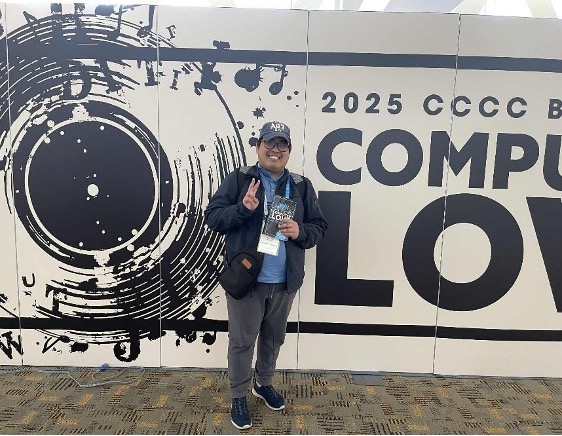
Fig.1. Me in front of the CCCC 2025 sign
A Supportive Home University
My knowledge of the CCCC came from my Rhetoric and Writing Studies professor and the director of the First-Year Composition (FYC) at Northern Illinois University (NIU), Dr. Ryan P. Shepherd. Prior to the convention, Dr. Shepherd volunteered his time and shared his experience in preparing and submitting a proposal for the CCCC. Together with other graduate students, Dr. Shepherd led a CCCC workshop in which he shared pieces of advice and resources to help us prepare for the conference. My key takeaways from the workshop were to make sure that my proposal connects to the theme and to present clearly what my research could contribute to the field, such as the things that writing instructors and scholars could learn from my presentation. Looking at model proposals also helped me frame effectively the rhetorical organization of my paper. During the workshop, I learned the importance of ensuring that my proposal engages my intended readers, which is exactly what we teach to our FYC students when they write for a specific audience. Using the first-person point of view in drafting my proposal was helpful in achieving reader engagement. I also made sure that the proposal’s theoretical underpinnings were clear, and the methodology was well-explained. The workshop inspired and motivated me to finish my proposal, and I could not thank our FYC director enough for the time and effort he dedicated to helping us get acquainted with the proposal drafting process.
The supportive community at my home university includes graduate students who also shared their CCCC experience with me. I am grateful for Melina Baer, our previous FYC director intern, for the information that she gave me on how to navigate a convention as huge as the CCCC and on how to enjoy and make the most out of the experience, such as visiting must-see places in the historic city of Baltimore. Knowing that our fellow graduate students are ready to help is another layer of bayanihan spirit that would prepare and perhaps excite any first-time attendee.
While preparing for the convention, I realized the instrumental role of our mentors and colleagues in creating a supportive academic village for those who do not know much about CCCC. It creates a ripple effect and enables previous attendees to share their knowledge and experience with others, helping newcomers foresee what the convention would look and feel like and assisting them in ensuring a successful proposal submission.
(Un)expected Reunions
I should say that for someone who has never been to a big academic conference like the CCCC, being at the convention center physically was very overwhelming at the beginning. I flew to Baltimore on my own, and I was not sure if there would be other graduate students from NIU who would also be participating in the conference. That anxious feeling of exploring the venue alone immediately faded when I saw two familiar faces from the crowd of participants who were in the queue to register. Two of my classmates were there! At that moment, CCCC became a mini reunion because I have not seen these classmates of mine for a long time. Their company made me more confident that I will be able to get through the day. We went to one of the afternoon workshops titled NNESWIs’ Remixing: Integrating Professional (A-side) and Transnational, Cross-Cultural Knowledge (B-side) of Teaching and Research. We learned about research projects that focus on university writing centers and exchanged ideas and questions with other participants in our roundtable. We also shared our experience as graduate teaching assistants who celebrate the varieties of English that our students bring into our writing classes. The three of us were able to debrief about the first day’s events over a late lunch at one of the restaurants near the convention center.
The other person from my university that I met was the newly minted Assistant Professor in our department. Meeting her was quite a reunion because I had already seen her before on campus during the search process for the position she applied for. I met the professor right after the opening general session on the second day of CCCC. She introduced me to her colleagues and recommended a couple of workshops and sessions on second language writing. I truly appreciated this gesture because I am also interested in conducting composition studies that involve second language learners.
Pleasantly Surprising Professional Encounters
Even if the first few workshops and sessions gave me the opportunity to meet other participants, I was still anticipating more events that would help me break the ice and establish more professional connections. Thankfully, the newcomers’ orientation gave me exactly what I was expecting. I sat at a table where a group of instructors from a community college in Maryland were also seated. Even if they were new attendees like me, they were not newcomers to the host city. Hence, I felt like they gave me a very warm welcome to the state of Maryland by suggesting iconic places to visit and must-try food items. I remember so distinctly how they talked about one of the best crab cakes in Maryland that even the former first lady, Michelle Obama, spoke highly of—the one that you can order from Boatyard Bar and Grill in Annapolis. We all enjoyed the newcomers’ orientation and exchanged contacts with other participants.
I am very thankful for the documentarian committee for organizing a welcome reception for the participants who volunteered for the job. I met other documentarians, and I was able to ask clarificatory questions about our tasks. I interacted with other instructors from New York and Illinois who graciously shared their poignant stories of their very first attendance to the CCCC. As a newcomer, it was very inspiring and humbling to listen to their nostalgic narratives, too. The Scholars for the Dream reception allowed me to connect with other graduate students who are trailblazing impactful research projects. By listening to their stories, I learned about how they are striving to complete their dissertations and create an impact through research. This got me thinking about how our research scholarship could help contribute to the good of the rhetoric and writing studies field. It was indeed enriching to connect with some of the awardees, such as Ty’kara from Old Dominion University, Francis from Wayne State University, and Dan from the University of Illinois at Urbana-Champaign.
I think that more than the beauty of the host city, what I remembered the most were the individuals who made my first CCCC a remarkable one. Indeed, sometimes, it is not the place but the people who make us come back. This is especially true for CCCC, where first-time attendees like me could meet scholars, educators, and researchers whose enthusiasm is contagious and whose scholarship is equally inspiring.
A Nurturing Community in Meeting Room 320
The highlight of my stint at the 2025 CCCC was that very moment when I stood in front of the participants who attended my session. The jitters were surely there, and it almost got the best of me. While waiting for the time to hit 9:30 in the morning, I was wondering if I would at least have one audience member who would find my presentation interesting. At that time, I was really questioning the value of my paper. The nerves slowly dissipated when I saw that there were participants who organically went to my session, in which I spoke about developing a research questionnaire to describe the components of meta-awareness about composition. What made that moment more special was the encouraging and reassuring demeanor of the audience members who, in my headspace, were silently cheering me on—“You got this, John Paul! We are ready to learn from your presentation.” The audience’s warm acceptance, despite my being a novice research paper presenter, fueled me to do my best and enjoy every bit of that learning experience.
I appreciated the nurturing community that was built instantly in my assigned meeting room. We listened to one another’s ideas on how the questionnaire could be enriched, and I was truly grateful for the expert advice that I got from the participants who are familiar with the methodologies I employed in the study. For me, the presentation was a refreshing experience, since I have never been to a conference or a professional event where, even if the participants are already so accomplished, they dedicated their time to listen to what I was going to say. At the end of my session, one of the audience members came up to me, shook my hand, expressed her warm congratulations, and reminded me to keep the passion in me burning. For someone who had doubted himself so many times, her words made a big difference. In fact, I now consider that encounter a core memory. It was also great to have a brief interaction with a professor from the University of Pittsburgh, who was there in my session. I left Meeting Room 320 with a smile and a grateful heart.
Extending the Community and Beyond
I did not expect that the CCCC bayanihan would continue even after the convention. I listed the names and contacts of the participants whom I met to maintain my connection with them. I took notes of their fields of expertise and made sure to contact them if I have questions or if I need resources for any research project in rhetoric and composition. A week after the convention, I received an email from one of the session attendees who is affiliated with a nonprofit research and innovation lab that conducts studies on literacy. The researcher gave me invaluable comments on how I could improve the research instrument that I shared during my presentation. She reached out to me to share an exciting project that also aims at validating a reading identity instrument. That meeting was very insightful, as it gave me a bird’s-eye view of what other writing scholars are doing to contribute to the field. I also received great advice on how to stay motivated to finish my dissertation project on time. Just like these encounters, I am also looking forward to connecting with other scholars and researchers for any collaborative research opportunities. Research collaborations are a great way to maintain a professional learning community where members actively learn from one another. With this, I would like to continue working on the research instrument I developed and connect with other writing scholars to help me refine it and further test its utility and validity in investigating students’ compositional choices.
Just like the concept of bayanihan in the Filipino culture, reciprocity allows any community member to walk in the shoes of others and be of service to them. Now that I have already gained significant experience on how the CCCC works, I am excited to take the role of a resource person for anyone who would like to learn about submitting a proposal for the conference or just the idea of sharing resources, stories, and expectations about the CCCC. I would like to pay it forward and continue a bayanihan that goes beyond the CCCC program book, meeting rooms, and presentation schedules. Truly, the unwavering support that we get before, during, and after any convention is what makes the Conference on College Composition and Communication a meaningful and fulfilling community to be in. I really hope to participate more in the years to come.