(Re)Constructing a Self in Timespace: Reflections on the CCCC in Baltimore
By Clay Walker
Tags: AI, Spacetime, Academic Identity, Friendship, Host City, SIG, Food, Art, Self

Attending CCCC allows me to (re)construct myself and in doing so open up to the potential for alteration. As I move through CCCC, I am continually (re)building my own identity through networked relations with colleagues, mentors, friends, and others at the conference through pursuits that I engage with in the various spaces I inhabit; through the work I bring with me (thinking, drafting slides, reading, giving a talk); and through the other cultural activities that occupy my time (wandering public spaces, eating at local restaurants, visiting the local art museum). I am actively (re)constructing my situation and my own self across the timescape of the conference as I interact with spaces, people, discourse, food, ideas, art, and other energies that circulate around the particular space and time of the conference.
Mikhail Bakhtin introduces the concept of chronotopes to account for how space and time are socially structured phenomena that implicate each other in the construction of our subjective identities and experiences, and thus are central to meaning-making. For Bakhtin, space and time are intertwined in a relativistic relationship of interaction that constitutes the underlayment necessary for meaningful action: we invoke ourselves as a certain kind of person in spacetime, and spacetime affords the enactment of certain ways of being (58-9). Time changes space; space changes time. Chronotopes situate us in a place. Space acquires meaning through the occupation of a given place in time (Dobrin 18-19), for by occupying and interacting within space, we bring “the past or the future into the here and now” (Gordon 46). Connecting our past pursuits with our imagined potentials to the present situation constructs context and creates affordances for action. Thus, as anthropologist Kristina Wirtz writes, chronotopes explain “our subjective experiences of space and time as necessarily context-specific, relative constructions, situated in (and productive of) histories of social relationships” (347).
Because chronotopes constitute affordances for interactivity, they establish the groundwork for ideology and meaningful action. Chronotopes describe the relationality of time and place necessary to create meaning and identity, but are not themselves totalizing forces. Like Bakkhtin’s concept of dialogicity, which was integral to James Paul Gee’s notion of Discourse, chronotopes may be interwoven with each other in various arrangements of dominance and dialectical influence (Wirtz, 348). The meaning of time and space are not absolute, thus competing relationships may co-exist, and in doing so, affect the differentiation of “experiences, persons, events, or things” (348). As Wirtz explains, chronotopes are both “semiotic products and interactional accomplishments” that allow us to understand how we construct the social relationships that produce events and memories (349). We construct multilayered relationships with other human and nonhuman actors to create assemblages (Yancey and McElroy). The constituents of these assemblages interface, providing energies or potentialities that vibrate (Halm), thus shaping the contours of the spacetime and opening up channels for meaning to emerge.
So much of the conference happens along the margins of the specific task I have been assigned for CCCC: to give the talk. A central chronotope of the CCCC conference consists of being an academic scholar who gives a talk, yet it competes with other chronotopes that transform myself, the space, and my activities in other ways, including friend hanging out or tourist wandering. A room in the conference center becomes a place of learning, the performance of academic thought and knowledge, and I act as an academic in giving a talk with slides, projector, microphones, etc., but the contours of this spacetime are multilayered and the chronotope of the academic talk are not totalizing. The room could be any number of other things, and at the end of my trip, the conference center reassembles as a performance space for young cheer athletes. The following essay chronicles my flows as I navigated the conference, (re)constructing a self in the spacetime of CCCC Baltimore in mid-April, 2025, with the hope that I can trace out some of the energies that constituted me in the timespaces that constituted my conference experience.
When I arrive at the airport on Wednesday in Detroit, I meet up with old friends and colleagues from Wayne State. We greet each other with hugs and warm welcomes: I’ve known them almost my entire professional life, and I feel most at home with them. We spend time catching up on former colleagues, our families, current work projects, gossip, politics, and so on as we wait for our flight. We create intimate spaces for conversation in the airport and on the train to the Inner Harbor. Once we arrive in downtown Baltimore, we check in to CCCC, get our decorative badge banners, settle in to our hotels, and make plans to meet up again for lunch. We share wine and eat seafood—I enjoy crab cakes that are delicate, savory, crispy. I try to be aware of each bite. I like starting the trip in collaboration with these two colleagues—seeing them always feels like a special treat. It gives me a sense of comfort because I came up into the profession with them. I can be more vulnerable here–they’ve known me as I’ve navigated professional and personal highs and lows. We’ve been students, friends, colleagues, collaborators, and supporters for fifteen years. Our conversations interweave these filters at once–problem deans, children growing up, current research projects, personal tragedies, funny memories. As I connect with them, I wrap myself in an affect of trust and a sense of roots in the profession and the broader CCCC community.
After lunch, I return to the hotel where I read interview transcripts from a study on generative AI and expertise to prepare for my CCCC talk. The hotel room opens up through the window overlooking the city, creating a more expansive space to read and think (see figure 1). The interviews were recently transcribed, so I am unsure exactly how I will incorporate them into my talk. I take notes on the transcripts, focusing on one clear emergent theme that relates to students’ concerns about generative AI’s inability to account for the context of students’ learning. So I am looking for some examples to illustrate this thread. I have a bit of uncertainty about how I will integrate these elements, but I am also confident that our panel will go well. I’ve given too many talks at this point, and I am familiar with this emergent feeling of uncertainty as I write. No doubt, I have completed less for this talk than I would have liked. Nonetheless, I focus on filtering down the data to elements I could share to illustrate the range of what students were telling us. It’s easy to focus in my hotel room, I feel like I have space to draw everything together as I look out over the Inner Harbor from my window in the evening.
I feel responsible for reading all of the transcripts, to be as comprehensive as I can for the presentation. It’s important to me that this goes well—I think our project can make an important contribution to the field. I think we have an ideal time and location for the talk, and so I anticipate that we might have a good showing for our panel. I am concerned with ambition in this moment, and that feeling shapes my focus and work. I read transcripts late into the night until I only see the interior of my room reflected back at me in the now darkened window that fills the room. I want to have all of the transcripts marked up so that I can focus on assembling passages into a sequence that makes sense for the talk in the morning, when I will feel refreshed.
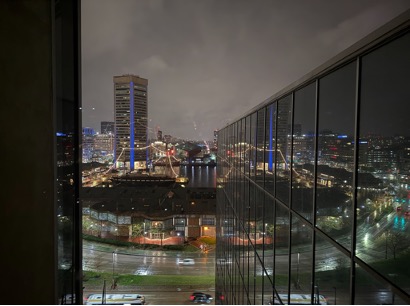
Fig.1. View of Baltimore from the hotel.
I rise early in the morning. The second-floor lobby of the Hyatt Regency Inner Harbor becomes my writing space in Baltimore Thursday morning (see Figure 2). I claim a spot at a long, high-top marble table, one of three positioned perfectly under the massive skylight that slopes up five stories at a steep angle. It feels close and cozy where I sit, but quickly opens to an expansive space. I am tall, so I prefer the high-top and its affordance for leg dangling. The tables also offer easy access to power, and I have a lot of work to finish getting ready for my talk. Through the steel beams that make up the expansive skylight, I can see the wooden masts of ships jutting into the sky over the harbor, a view that feels both larger than life and calming. Beyond the rows of marble high tops, I see several long couches arranged around the lobby with large sections of open floor space interspersed. Along the perimeter of the lobby, a series of cement columns stretch up to several floors above me. I can see movement along the corridors of each of the floors as service staff set up the restaurant that overlooks my writing place while guests walk along the open hallways towards the escalators and elevator. Among these cement columns, the glass-encased elevators silently slide up and down their vertical tracks at the far end of the lobby behind four tiers of soft lighting that stretch up several feet to mark the start of the third floor.
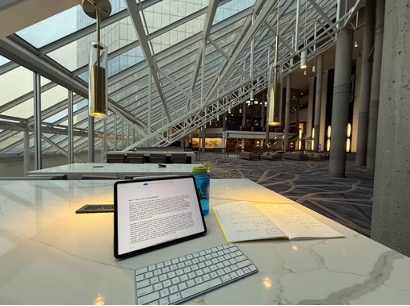
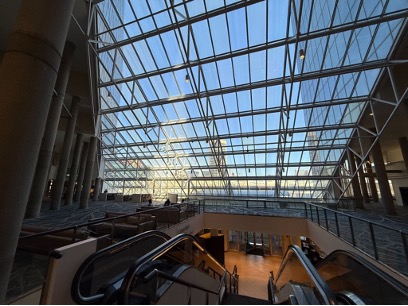
Fig.2. View of the second-floor lobby with its slanting window and colonnade (left). View of the steel reinforced window of the second floor lobby from the top of the escalators that lead down to the first floor (right).
In between all of these architectural and decorative elements, the open air fills the room, and I can hear a subdued jazzy electronic music coming from somewhere beyond the tables where I sit. I can see the air in this space—it gives me a feeling of openness to work on my presentation. I brought with me the annotated transcripts, a title for the talk, and a general outline for the argument, but I am not sure yet how much of the transcripts will make their way into the talk itself. People walk along in pairs now and again heading to the market behind me, and I wonder if they are here for the conference? I sense that I am on the periphery but getting closer to the conference. It’s early on the first presentation day of CCCC, and I am not yet certain how close I am to the official conference spaces. Nonetheless, I focus on updating slides and rehearsing my talk.
I have been to Baltimore once before, almost 11 years ago to the day when we visited family living in Arlington County, Virginia. I went to the inner harbor with my family, including my two young boys, to see the historic ships - the submarine USS Tork and the USS Constellation, a Civil War era sloop-of-war powered by sail whose masts loom over my workspace against the soft grey sky of the morning in the window above (see figure 3). I recall fond memories of walking around the ships with the boys, going below deck, pretending to work on the ships, imagining the cannon fire. I also recall the feelings of conflict and pain as my marriage began to fall apart on that trip. These memories float like undercurrents - activities from a lifetime ago, memories of another Clay entirely. I am generally feeling good, although a bit under pressure since I have to finish some prep work for my talk. We’ve had major and unexpected problems with our house the last few months that required all of my attention, severely limiting the extra time I have for research and writing in my non-tenure track teaching job. Being at the conference allows me to just let go of that stress and focus on the work, but I know I will return to the thick of it when I go back home. Given the problems back in Michigan, I was late getting started on my paper for CCCC.
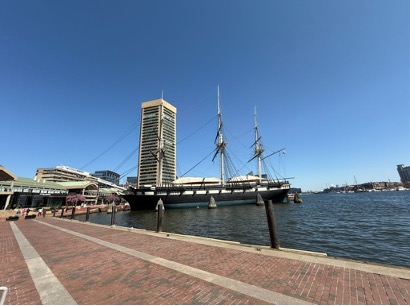
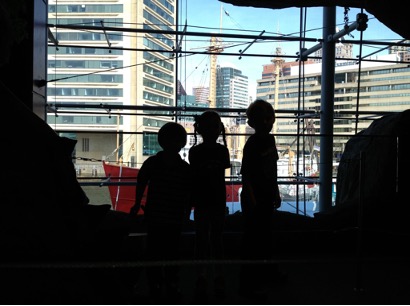
Fig.3. The USS Constellation in the Inner Harbor, April 9, 2025 (left). Silhouettes of my two boys and a family member looking out at the USS Constellation on April 13, 2013 (right).
After working for a couple of hours in the morning, I meet with my panelists to quickly rehearse our talk around the marble table. We’ve been working closely over the last year on this project, so although this will be the first time we present our findings, we’ve been talking about the project quite a bit. The study examines how students use GenAI to develop expertise in their undergraduate degree programs. We are excited to share the talk with the CCCC community, but we’re also thinking about this as a dry run for a talk we will give at our institution — we are concerned about the administration’s interests to leverage AI to reduce the cost of human educators. So while sharing our work with other writing studies experts is certainly important, the future stakes loom a bit. Nonetheless, we head to give our talk by late morning. The panel goes well and the string of excerpts I selected from the interviews brings the students into our presentation, allowing them to talk about how they see AI—some of the humor and anxiety inherent in the study participants’ responses comes through. People laugh when Bartholomew calls ChatGPT “the biggest yes man that ever existed.” The panel as a whole seems to resonate with the audience we have, even if it is not as well attended as I hoped. But I do make an important connection with someone working on a similar project. I am not great at networking with new people at conferences, so I am relieved, excited, and hopeful to have this positive experience.
After our panel, I spend the day moving in and out of personal and professional relationships. I attend the talk of one of my friends and current colleagues with whom I share an office—I am surprised by her presentation and didn’t know much about what she was working on. It turned out to be one of the best talks of the weekend for me. After her talk, we chat walking down the long hallways of the conference center looking for a place to grab coffee. I encourage her to run for the executive committee in our program and we talk about institutional politics. I meet with a colleague from another institution that I don’t really know to talk about how our technical communication program works. He’s trying to solve his own institutional problems. That evening, I meet up with an old friend and mentor at her panel, then we head to a restaurant. We spend a few hours catching up, talking about work projects, family, current political issues, and the futures we see before ourselves and the field. We walk back to the hotel and share a warm goodbye. I end the night with my work friends for drinks at the restaurant that overlooks the marble tables I’ve been working at in the mornings. We cluster around a high top in the bar to chat about our personal lives, gossip about our department, and to share our thoughts about the new leadership in the College. It’s nice to spend time as friends and not just colleagues on a committee. I love these social elements of CCCC where I can build relationships. There is time and space to chat, laugh, and connect with other people without the pressures of students and classes or family and home to distract me or marshal my agenda. I like being able to move between intellectual work and shooting the shit.
Friday morning, I find myself sitting very near the same place I started my day yesterday. The lobby seems much busier with more conference-goers working at tables on their laptops alone and in groups of two. The market and Starbucks coffee shop, which is just behind me, fills up with people getting breakfast sandwiches, mochas, coffees, and the like. I see people walking around the elevator corridor with their lanyards dangling as they browse program books. The space in the lobby is a mix of light and dark as the upper floors are unlit while the expansive skylight fills the room with soft natural light. Yesterday I worked from this spot, but everything was different. I anticipated my own talk, feeling anxious that I wasn’t fully ready. No one was around. Today I don’t have to perform anything, so I feel free as I head to the conference. The highlight of the day’s panels is the “Cutting Through the Noise: Data-Driven Research on Generative AI and the Teaching of Writing” panel with Matt Vetter, Brent Lucia, Jialei Jiang, and Daniel Hocutt. I was eager to see this presentation, and so were lots of other conference goers, as the room quickly overflows with people sitting and standing on the floor around the room. Panelists give up their chairs so the audience can sit. The room buzzes as the talk starts, and it feels like being part of a unique moment in CCCC history. I had never seen a panel outperform its room as this one does. I am engaged, contribute a question, and walk away feeling connected to the field and the conversations that we just shared.
I end the conference day at the Writing and STEM SIG. After the business meeting ends, I walk to dinner at an Ethiopian restaurant with a colleague that I hadn’t really talked with much before. We get to know each other while making our way several blocks in the rain as the evening begins to fall. We head to an Ethiopian restaurant that looks like a complete hole in the wall, but it’s situated in a predominantly Ethiopian neighborhood, and the food turns out to be spectacular. We share a large platter of Ethiopian dishes at the bar. The TV in front of us plays a YouTube video of an Ethiopian DJ, The Supercat from Addis, mixing Ethiopian jazz and traditional music from a listening room in Copenhagen, and we drink bottles of Habesha, an imported Ethiopian beer. Both of us talk about the vibe in the restaurant–it feels just right: comfortable, warm, interesting, unexpected. Next to us sits another woman from the conference - she’s eating alone and we chat with her for a bit before she leaves. After we finish eating, we share a cab back to the hotel because it’s late, cold, and rainy. I don’t know if the two of us will have another experience like this again, but we leave as friends.
Saturday morning, I write from the second-floor lobby of the Hyatt at the same tall marble table where I started the week. I like the open space here—it gives me room to think and focus. I write while listening to the Ethiopian DJ from last night. Around me, the scene is very different from yesterday. I only see one CCCC person—she looks like she's packed and ready to leave the hotel. Otherwise, I see lots of young girls dressed for dance or cheer all around the space. They make their way with their families out of the elevator, walking down the stairs, and streaming past me toward the conference center. The whole vibe of the space has changed as these young girls practice routines and fidget around as young people do. The energy fills the lobby. It's raining outside, and I can see the water on the skylight, streaming down the glass. I work for a few hours this morning reading and taking notes on Generative AI from the perspective of software developers. This work helps me better understand how GPTs create meaning from a computer science perspective and to understand how algorithms write. I write dozens of pages of notes that I will use later to create lectures on algorithmic voice.
Close to midday, I stop working and call for a Lyft to see some art museums in the city—the Baltimore Museum of Art and the American Visionary Museum. I always combine a CCCC trip with a visit to the local art museum. On this trip, I spent a lot of time looking at Paul Cézanne’s “Mont Sainte-Victoire Seen from the Bibémus Quarry” (see figure 4). I like to look at how the brushstrokes create color, form, and line. I focus on the looseness, the structure of the composition, and the juxtaposition of the colors. I study how the abstraction turns into form and meaning. I move through the museum alone, but I feel full from looking. I think about painting while I am looking at Cézanne’s work because I don’t spend as much time painting as I would like. I am thinking about my own painting style and I can see how my brushstrokes are similar, I observe how the direction of his strokes and the saturation of the paint create visual effects. I do the same thing with several other landscapes and still lives in the museum from the late 19th or early 20th centuries. I take close up photos that I probably won’t ever look at again, but taking the photos focuses my thoughts and attention in the moment.
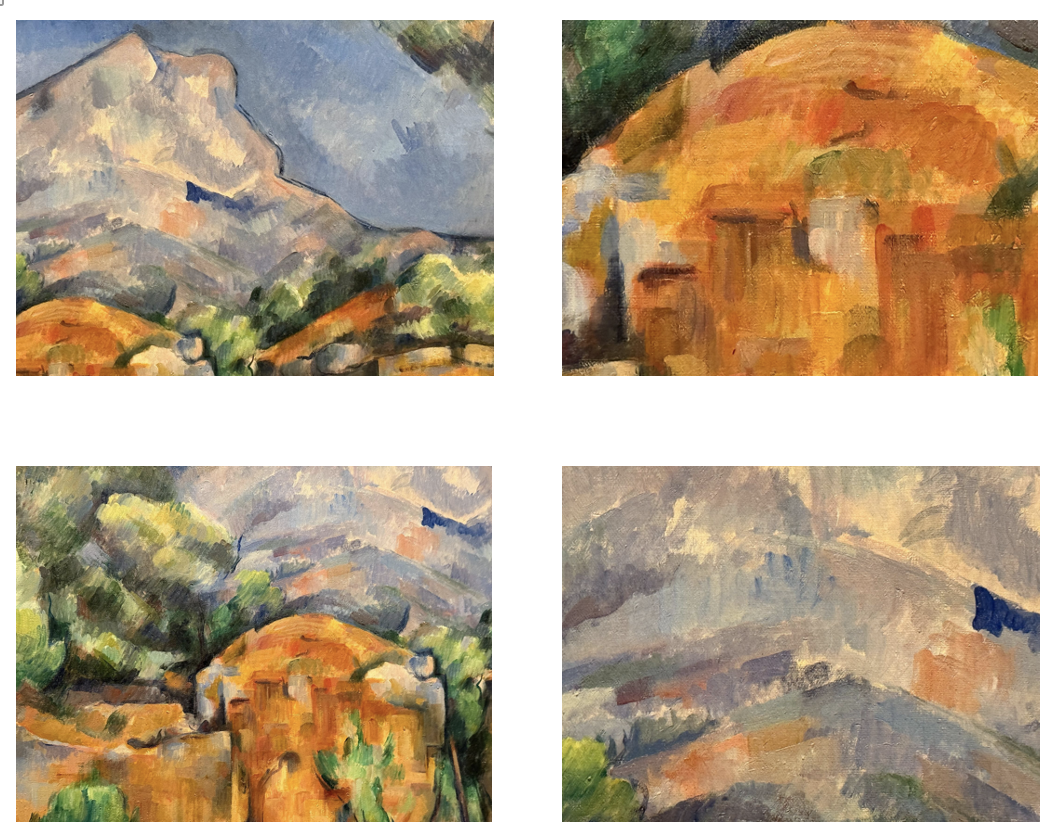
Fig.4. Details from Paul Cézanne’s “Mont Sainte-Victoire Seen from the Bibémus Quarry,” oil on canvas, 1895-1899.
After the museums, I wander around the Inner Harbor, following the water and peering into shops. I find my way to a wood paneled seafood restaurant called the Rusty Scupper with the help of some quick Google searches. I can’t afford this restaurant but I eat there anyway. I order a gin drink and more seafood than I can probably eat while taking in the restaurant’s views of the harbor and listening to the jazz playing over the speakers (see figure 5). This will be my last experience at the conference. I don’t mind spending this time alone - it gives me a chance to think about myself and what I’m doing or trying to do. I like the quietness of the meal. I think about how the solitude of our profession is something that I like about my job. That fact rings true as I sit now alone writing this manuscript, listening to my downtempo electronic playlist, even while others/my family linger in adjacent rooms.
The frequencies from Baltimore resonate in these recollections and I can see how my assemblages shift as I move from space to space across the timescape of the week. In the end, what I take from CCCC Baltimore is not only the set of ideas exchanged or the talks delivered, but the ways the conference’s spaces, energies, and relations reverberate through me—how they attune and reconfigure the self I bring into being through writing. The chronotopes of the week—the airport reunion, the marble table under the skylight, the crowded AI panel, the quiet museum galleries—each assemble their own discursive and affective order, shaping who I am and how I move. Writing this now, I can feel how those moments continue to vibrate across timespace, folding back into the ongoing process of (re)constructing a self in relation to others, to place, and to the ambient materialities that make up our shared scholarly lives.
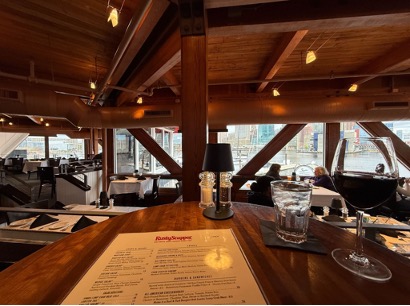
Fig.5. View from the Rusty Scupper looking out at the Inner Harbor.
Works Cited
Bakhtin, Mikhail Mikhaĭlovich. The dialogic imagination: Four essays. Vol. 1. Edited by Michael Holquist. Translated by Caryl Emerson and Michael Holquist. University of Texas Press, 2010.
Gee, James Paul. Social Linguistics and Literacies: Ideology in Discourses. 4th ed. Routledge, 2015.
Halm, Matthew. "Transduction and the Conceptual Overlap between Multimodality and Transfer." College Composition & Communication 76, no. 4 (2025): 518-541.
Lamos, Steve. "Drumming a Literate Life: The Pursuit of ‘Resonant Literacy’." College Composition & Communication 73, no. 2 (2021): 312-337..
Roth-Gordon, Jennifer. "Situating discourse analysis in ethnographic and sociopolitical context." The Cambridge handbook of discourse studies (2020): 32-51.
Wirtz, Kristina. "The living, the dead, and the immanent: Dialogue across chronotopes." HAU: Journal of Ethnographic Theory 6, no. 1 (2016): 343-369.
Yancey, Kathleen Blake, and Stephen J. McElroy. "Assembling composition: An introduction." Assembling Composition (2017): 3-25.