Origins of WAC at the University of Denver
by Douglas Hesse
DOI: https://doi.org/10.37514/TWR-J.2026.6.1.01
Included in this gallery are eighteen artifacts that document key moments in Writing Across the Curriculum requirements at the University of Denver (DU). The effort was part of comprehensive new writing program I founded in 2006 and directed until 2021. The new program radically changed how writing was organized, staffed, and taught at DU, a private Research 1 university founded in 1864, which enrolls some 12,000 students (half of them undergraduates) and is located on 125 acres in a residential neighborhood of the city.
The gallery mainly focuses on a writing intensive Advanced Seminar (ASEM) course, which serves as the required capstone of the general education program. DU currently (2026) offers about 70 ASEMs per year, multi-perspectival courses taught by faculty from departments across the university. To clarify the context for ASEM, I've included artifacts from the larger writing program. The following sections discuss why these artifacts might be useful to WAC scholars and practitioners and give a recent brief history of the writing at the University of Denver, setting the context for WAC and the Advanced Seminars. I've provided an annotation for (and sometimes an extended discussion of) each artifact included.
1. Significance of the Gallery
Our professional literature has stories of how programs started during the founding days of writing across the curriculum, at places like Beaver College, Michigan Tech, Coe College, Missouri, and so on. The collection here provides a documentary history of a program begun in the late middle of the WAC movement, in the 2000s, at a particular kind of institution with significant resources and commitments. While the field's histories provide comprehensive portraits of what happened and how at particular schools, actual artifacts--both mundane and substantial--are less common. WAC programs exist through emails and committees, through budgets, documents and reports, and they exist in the context of other campus writing efforts and cultures. From hundreds of materials, I've curated a few to document how WAC emerged relatively from nowhere at The University of Denver.

2. Undergraduate Writing at DU Since 2005: A Snapshot
Impelled by a $10 million gift from the Marsico Foundation, the University of Denver revised general education in the early 2000s.[1] A faculty-led process culminated in a vote that had over 70% of the whole faculty approve a comprehensive new writing program, which featured an entirely new first year writing sequence, a writing center, a writing-intensive general education capstone, and support for writing across the curriculum, including in a new first-year seminar program. I was hired in 2006 to start and direct the new program, which was symbolically housed in renovated space in the university library. I reported to the provost, who provided central funding for its $1.7 million initial annual budget.
The most dramatic element was replacing a traditional first-year writing faculty of adjuncts and TAs with permanent full-time lecturers, positions later converted to teaching professor lines on a ladder track: assistant, associate, and full. The new writing professors taught a 0/3/3 load in a quarter system, with full benefits including research and travel support, in courses capped at 15 students, a load calculated to allow the writing faculty to provide "a campus-wide resource for writing."[2] I conducted national searches and hired nineteen faculty (increased to 28 by 2020) and a new writing center director, Eliana Schonberg. Previously, instead of a meaningful writing center, DU had a table in the library where students could ask grammar questions of untrained graduate students. Eliana educated a staff of ten English PhD students as the first professional consulting staff.[3]
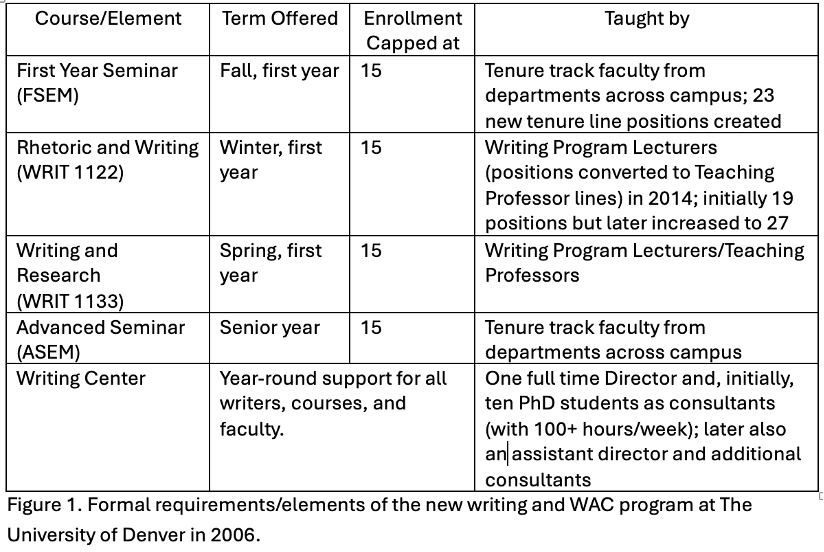
Prior to 2006, incoming DU undergraduate completed a three-course (fall, winter, spring) first year writing sequence, the last course being writing about literature. Beginning in 2006, all undergraduates were required to complete a fall First Year Seminar (FSEM), two first-year writing courses (one each in winter and spring), and a senior-level capstone general education writing intensive course (Advanced Seminars or ASEM), all in sections capped at 15. To build capacity for small writing-intensive courses, in addition to the new writing faculty, DU added 23 new tenure-lines across campus. I had administrative responsibility for FYC and ASEM, plus faculty development responsibility for all campus writing efforts, with Dr. Schonberg providing additional expert help with the latter. Figure 1 lays out elements of the new writing program, and in the sections to follow, I discuss each one.
2A. First Year Seminars (FSEM) and WAC
First year seminars became a universal requirement in 2006. From the outset, they were imagined as thematic, content rich courses, taught in sections of fifteen to create an inquiry-based introduction to college. FSEMs were designed to be taught by tenure-track faculty from across the university, mostly from the College of Arts, Humanities, and Social Science and the College of Natural Sciences and Mathematics. As I noted above, to increase capacity to offer the 70+ sections of FSEM each fall (and the 70+ sections of Advanced Seminars that I describe below), DU created 23 new tenure lines. The catch phrase, even before I came to DU and continuing now, was that courses would focus on a subject of the professor's passion. From a long menu of seminars, students selected one that matched their interests. While there was a small "introduction to college" component, marked by the FSEM professors being first year advisors to their students, the focus was "serious inquiry," not orientation or readiness skills.
The small courses were designed to facilitate discussion, active learning, and writing. Curricular space for FSEM was opened by reducing the first-year writing sequence from three courses to two. The idea was that students would still have a full-year sequence of small, intensive courses. FSEM students would perceive straight away that writing was important in college, that it differed from the kinds of writing they'd done in high school, and that they needed to develop more skill and facility with it. As a result, they'd be more attuned to the WRIT 1122 courses in the winter and WRIT 1133 in the spring. The seeds of instruction in rhetoric and writing would thus fall on more fertile grounds. Or so many of us imagined.
But not all campus faculty thought FSEM should be writing-intensive. Some (often in mathematics and the natural sciences) suggested that their course might emphasize other kinds of active learning. The compromise was that the courses would require engaged learning: projects, discussion, and the like, not lectures. Writing was promoted as perhaps the most obvious means of engagement and the default. It wasn't obliged, but according to student reports each January, most FSEM sections had extensive writing.
However, the nature and purpose of that writing wasn't specified. How much was to be formal, and how much informal? In terms of "formal" pieces, what was the target discourse: Disciplinary writing? Popular writing for general educated audiences? Some kinds of assumed "general academic writing?" Furthermore, what responsibilities did FSEM faculty have for teaching writing? Were they to provide instruction? Teach concepts and strategies about writing? Read and respond to drafts? We learned many of those questions through a large survey of campus faculty that over 300 colleagues completed. (See Artifact 1.) The writing program sponsored sessions to clarify expectations for faculty and to provide support, as exemplified in Artifact 2. As I'll show below, we developed an extensive faculty development series (including paid multi-day workshops). The initial events were "triage" for faculty engaging new courses.
Artifact 1: Findings from a Faculty Survey of Writing Assignment Practices and Beliefs. Wanting to gauge the campus climate, in January 2007, we surveyed 321 DU faculty to learn what writing they were assigning and what they thought about writing.
Artifact 2: Email Learning Opportunities for writing in FSEM. A September 2006 email to professors teaching first year seminars, inviting them to early workshops.
2B. The First Year Writing Curriculum and WAC
During the winter quarter, students in the new first-year curriculum took WRIT 1122: Rhetoric and Writing, which focused on rhetorical principles for civic discourse. In the spring, they took WRIT 1133: Writing and Research, which focused on the relationships between epistemology and rhetoric in three disciplinary traditions: textual interpretation, empirical/measurement-based research, and qualitative research. A key feature of the course was that students completed three primary research studies, rather than simply analyzing published studies. In one of my classes, for example, students addressed a question that the university's chancellor asked me at a campus dinner: Do our students read the news? They organized a survey of over 400 students, interviewed dozens of them, and wrote reports that I shared with the chancellor.
Artifact 3: WRIT 1122 and 1133 Course Goals and Features. Here are FYC requirements as the writing faculty developed them in fall 2006. The courses were designed to lay important groundwork for subsequent WAC efforts, providing a vocabulary and heuristics for WAC and WID by teaching rhetorical concepts and analysis, emphasizing how discourse conventions are situated in disciplinary and other communities, and so on.
3. The Advanced Seminar (ASEM) Program
Bookending FSEM was ASEM, the Advanced Seminar. The new general education plan had students complete three upper level "Core Courses," one of them writing intensive. When I arrived in July 2006, an early task was to establish what writing intensive meant and to approve courses. Unfamiliar with how curricular changes happened here, I asked Provost Greg Kvistad about the curriculum process and was told, "We hired you as the expert. Just tell us what we should do." Tantalizing as this power was, it was also dangerous for campus investment and legitimacy. I had myself appointed to the Faculty Core Committee, which approved courses and distributed some professional support funds, and asked to chair a small subcommittee of that group. This was in October, and we worked quickly. After surveying what constituted "writing intensive" in programs around the country, we decided on four requirements:
1. Students will write a minimum of 20 pages (about 6000 words), some of which may be informal, but some of which must be revised, polished, and intended for an educated readership.
2. Students will complete a minimum of three writing projects that are distributed over the quarter; exceptions might include a cumulative project completed in multiple stages.
3. Students will revise some of their work based on feedback from their professor.
4. There will be some instructional time devoted to writing.
The Core Committee approved them, and we put out a call for proposals. By the spring of 2007, DU was already teaching Writing Intensive Core classes, a stunning pace of implementation that would have been impossible at most schools. We defined "Writing Intensive" entirely in terms of instructional requirements and features, not goals or outcomes, which led me later to address faculty questions about the purpose of writing in ASEM. Was it simply more writing to learn, or were students to develop further writing? If the latter, who was the audience? After all, upper level courses in majors tended to focus on disciplinary discourse, but these weren't courses in the major.
Artifact 4: October 25, 2006, Email documenting the process and timeline for designating Writing Intensive Courses. Demonstrates how quickly ASEM was developed and by what means.
Artifact 5: A Study of Writing Intensive Requirements Across the Nation. Faculty inevitably want to know what other schools are doing. I did a quick and dirty report on requirements at several schools in fall 2006, which I shared with the Core Committee and made available to faculty across campus on the Writing Program website.
Artifact 6: Expansions and Explanations of the ASEM Writing Requirements. A detailed explanation of the four elements required to earn ASEM designation.
DU modified general education requirements again in 2009, renaming them The Common Curriculum. The core courses disappeared and ASEM, a general education capstone, became the new writing intensive requirement. I was named chair of the ASEM Committee and appointed to the five-member Common Curriculum Council. Here's the description of ASEM that appeared in the Undergraduate Bulletin (the university catalog):
Successful people navigate complex political, social, cultural and economic environments that challenge more traditionally limited concepts of higher education and competencies. To help students better understand the demands of contemporary life, instructors teach advanced seminars based in their area of expertise and passion. The topic will be approached from multiple perspectives in a course designed for nonmajors. Studying in this setting, students demonstrate their ability to integrate different perspectives and synthesize diverse ideas through intensive writing on that topic. This course must be taken at the University of Denver. Students must complete all other common curriculum requirements before taking the Advanced Seminar.
We adopted two broad outcomes for ASEM courses, calling for students to demonstrate the ability to
1. Integrate and apply knowledge and skills gained from general education courses to new settings and complex problems.
2. Write effectively, providing appropriate evidence and reasoning for assertions.
The goals proved challenging for both implementation and assessment. The first emphasized "multiple perspectives" and "integrating knowledge," differentiating ASEM from capstones in the majors and explicitly privileging general education. But with complex and varied paths through general education to arrive in the advanced seminar, students would reasonably have quite different bodies of knowledge and skills. Faculty faced difficulties planning assignments that emphasized specific prior knowledge. Even when students showed evidence of integrating prior knowledge and skills, it was impossible to discern whether they gained them from "general education courses," from majors courses, from self-sponsored reading, or so on. As a result, assessing that outcome was nearly impossible. In 2013 the ASEM committee revised the goal to read, "Demonstrate the ability to integrate and apply content from multiple perspectives to an appropriate intellectual topic or issue."
The writing goal, while less problematic, was--and is--still complicated. It privileged one kind of writing, generally argumentative, that makes assertions and provides evidence and reasoning for them. Despite these being reasonable goals for academic writing, one could imagine ASEMs that prized different kinds of writing. In fact, many did. Moreover, the goal was silent about matters of genre and audience for course writing. To some large extent, this was desirable, allowing leeway to define the kinds of writing faculty wanted to assign.
To support conditions for writing, seminars were taught in classes capped at fifteen. Intensive faculty development was required of anyone teaching ASEM. Starting in winter 2007, professors attended a three-day workshop, with assigned reading and writings, for which they received $1000 (and which accompanied another $1000 for designing the course). These workshops focused on writing as a mode of learning, developing and sequencing writing assignments, the nature of writing development during college years, responding to writing, writing-related activities during class time, grading, and so on.
In 2009, I produced the first edition of Writing Beyond Writing Courses: Resources for University of Denver Faculty, to support faculty in various campus WAC efforts. Included here is the second edition. By 2020, over two hundred colleagues had participated in formal paid workshops using this guide, most of them in conjunction with ASEM. The book reflects practical and rhetorical decisions I made to ramp quickly a universal WAC requirement. I had two reasons for creating it, one practical, the other promotional.
Artifact 7: Writing Beyond Writing Courses. A 40-page guide to WAC resources I developed to support faculty workshops and to promote writing broadly across campus.
For the first several three-day ASEM faculty workshops, I supplemented John Bean's Engaging Ideas (which the writing program bought for all participants) with a series of handouts. Each workshop, then, involved a sort of chaotic photocopy fest of documents that struck me as most useful. I figured it would be more coherent and efficient to consolidate everything into a single place and print a couple hundred copies. Because I used the volume in many campus settings, I reprinted the volume frequently.
Doing what little design I could manage with Word gave the collection some polish. That helped it serve a second, promotional purpose. We could send copies to campus administrators and bring them to writing program events. When I put a PDF on the Writing Program website, the book gained some attention from faculty and WAC directors around the country. The latter found it a useful resource, likely because it was free and condensed, and when they asked if they could link to it or download for their own campuses, of course I agreed. Creating the book involved less writing than assembling. I selected documents that seemed most worthwhile, found the Word files or scanned images, and organized everything into a single document.
By far, I received most comments, both in campus workshops and from national users, on the single page "Thirteen Ways of Looking at Responding." Faculty seemed to appreciate the reassurance that they didn't need to be superheroes to give useful feedback. The second favorite was one of the response heuristics that suggested checking off minimal criteria for a grade of C, offered further criteria for higher grades, and included room for single "one strength" and "one improvement" comments. Rubrics had yet to saturate higher education in the 2010s, and this was the first encounter with them for some professors. Despite my own enthusiasm to craft innovative writing experiences, my colleagues across campus overwhelmingly were more interested in reducing time they spent responding and knowing that they were providing useful feedback. No surprises. But many were intrigued by options in assignment making, particularly the illustrations of "stark" v. "elaborated" assignments.
For my purposes, the conceptual materials about writing and learning to write--the synopses of theory and research--were most vital. Partly this was on behalf of students, who needed their professors to grasp the complexities of the writing transformations they were being asked to make. Partly, though, I was acting on behalf of writing studies and the writing program, demonstrating that there was a "real discipline" of writing studies, not just an ad hoc set of knacks, many of them designed for remediation. I'll note that this second desire sometimes worked at cross purposes with the faculty need for reassurance and simplicity. Impressing them that writing studies was serious business, fully warranting PhD training, caused a few to pause: "I'm no expert; what business do I have?" Still, recognizing that writing studies was a field with expert knowledge is a healthy state.
Nearly 200 University of Denver faculty participated in the initial ASEM workshops over the years, and about half of them also participated in follow-up and related workshops or institutes, described in Part 4 below. Artifact 8 lists the 213 ASEMs approved as of 2021.
Artifact 8: Catalog Listing of All ASEM Courses as of 2021. By the time I stepped down as Executive Director of Writing in 2021, the ASEM committee had approved 213 courses; included here are the ASEM descriptions from the 2021-22 University of Denver Bulletin.
Artifact 9: Documents from Action Research Project. For the first comprehensive assessment of writing in ASEM courses, I gathered (and paid) a group of 11 faculty to read and code student writings from ASEM courses, including their own. I was able to pay students to complete a detailed survey and allow us (through informed consent) to study their writings. This artifact provides details about the project (including the call for applications), a list of participants, the student informed consent form, and more.
The official requirements for assessing learning outcomes in general education courses were minimal and, to my mind, irresponsible. Faculty were asked simply to report what percentage of students were meeting, exceeding, or failing to meet each learning outcome. Relying on faculty impressions made it quick and convenient for them to provide assessments, but these were scarcely grounded in evidence and didn't even have the rigor of final grades, I thought. I determined to conduct a more rigorous assessment, which I wanted to combine with professional development. I had faculty collect student writing, and then I gathered all eleven participants for intensive sessions in which they read and coded artifacts from across the program. For an article detailing this process and reporting findings, see Juli Parrish, Doug Hesse, and Geoffrey Bateman, "Assessing a Writing Intensive General Education Capstone." Across the Disciplines, December 2016. DOI: https://doi.org/10.37514/ATD-J.2016.13.4.22
Artifact 10: Report on Faculty Analyses of the ASEM Program. In 2017, I convened an institute to reflect on the strengths and weaknesses of ASEM. It had multiple phases. Faculty individually answered several questions about ASEM, then read and discussed one another's writings and tried to synthesize some findings. This artifact is the report from that effort.
Artifact 11: Syllabus for ASEM 2499: Mountains: Ecologies and Imaginations. Finally, offered as an example is the full syllabus for an ASEM course I developed and taught a half dozen times. It includes all writing assignments: projects, exercises, and daily writings.
4. Faculty Development Beyond the ASEM Workshops
The formal professional development for the ASEM program was the initial three-day workshop. However, we sponsored regular follow-up activities, most of them scheduled during the December and June breaks. We paid faculty for participating. Artifact 12 illustrates one of these extensive follow up workshops. Article 13 illustrates lower stakes, even lighthearted opportunities.
Artifact 12: Invitation to a 5-Day Writing Institute. Here's an example of the many institutes, ranging from a single day to five, we created to pay faculty to develop course materials in the company of colleagues from across campus.
Artifact 13: 55-Minute Faculty Workshops. Included here is a whimsical flyer as an example of the teaching tips sessions we routinely offered. Brown bags and similar short, informal events were/are fairly routine in WAC programs. Here is how I spun them.
Many of the extended workshops usually had faculty create and sharing course materials or analyses. Artifacts 14 and 15 document publications resulting from those activities.
Artifact 14: Teaching and Troubling the Writing Intensive Core. I edited two volumes of essays written by DU professors about their ASEM courses.
For the first dozen years of the ASEM program, my budget allowed paying professors $500 to write an article about their courses. They could submit an article at any time, and when I had enough to create a volume, I gathered and edited them. We printed copies that I used in subsequent faculty development activities, and professors inevitably found interesting (and sometimes intimidating) what their colleagues across campus were doing and thinking. I also shared the volumes with chairs, deans, and the provost. Many colleagues reported these were compelling artifacts for the teaching portions of their tenure and promotion files.
Artifact 15: Student Writing in FSEM and ASEM. This short, informal collection of essays presents faculty analyses of "good" and "average" writing in one of their courses.
We invited colleagues to bring two pieces of student writing from one assignment: a writing they considered strong and a writing they considered average. My colleague Brad Benz and I asked them to discuss the features of the two writings. What made one better than the other? Part of the workshop included our providing a vocabulary for analyzing student writing.
Figuring one way to garner faculty interest was appealing to their identities as researchers, I created the Writing in the Majors Project (with the intentionally self-deprecating acronym play on "wimp") and invited departments to apply for grant funding. Over a couple years, a dozen departments did, ranging from chemistry to economics. The call for proposals, included as part of Artifact 16, lays out the parameters. We funded a team of two department faculty (at least one senior) and two undergraduate majors, all receiving stipends, plus two writing program faculty. The team created its own research questions and methods (with writing faculty offering expertise and will,) and produced a quick and dirty report (to avoid dithering) that the department would own.
Artifact 16: The Writing in the Majors (WIMP) Project. This artifact contains several elements: A call for participation in a department-based research project involving disciplinary faculty, student majors, and writing program faculty; the list of participating departments; and, as illustration, a draft report from the philosophy study, used with permission of the current philosophy chair and the chair at the time of the project.
5. A Last Layer: What, Why, and How do DU Students Write?
The most substantial research project we undertook to support WAC began in spring 2007. Several colleagues and I began a longitudinal study of undergraduate writing that resulted, 5 years later, in a massive repository of data. There was a basic research imperative for this study, but there was also a strategic imperative for establishing writing on campus as a field of research with disciplinary knowledge. For an example of findings from the study, see Eliana Schonberg and Douglas Hesse, "Further Findings and Methodological Advice from an (Overly) Ambitious Longitudinal Study of Undergraduate Writers," Proceedings from the 2023 Writing Research Across Borders Conference. Ed. Paul Rogers, et al. In press.
Artifact 17: Overview of the University of Denver Longitudinal Study of Undergraduate Writing. This document provides an overview of a massive multimodal longitudinal study that tracked 59 students four years, collecting all their writing (9.9 million words), with surveys and interviews.
Artifact 18: PowerPoint from the 2011 Provost's Lecture. Each year the provost invites a member of the faculty to give a campus-wide lecture on some aspect of their research. Included here are PowerPoint slides from my lecture on the longitudinal study of writing, which was still in progress at the time of my talk.
6. Reflections
I've described higher education and WAC conditions that may now seem remote and inaccessible. I started a WAC program at a place where faculty before me had made the essential case for a campus writing effort. I showed up with the simpler task of figuring out how to make things work. And while I didn't exactly have a blank check, I did have a generous budget, one that allowed me to pay stipends, support research, and create publications. Such conditions are pretty rare these days, and WAC as a point of campus pride and investment has dulled across higher education, as it has at the University of Denver, where all things STEM and job skills stand shiniest and where conditions of faculty enthusiasm I enjoyed have been muted into near silence. I hope this gallery doesn't simply preserve what turns out to have been a fast-receding opportunity, overgrown, an Angkor Wat of WAC.
The artifact that seems most important to me is Writing Beyond Writing Courses. In fact, I started by wanting simply to upload it to the WAC Repository as a single object, but as I wrote about it, I realized a larger context would be useful. Writing Beyond lived a good life in professional development and as ambassador for a new program, both on campus and abroad. Aspects of the guide are clearly dated, even if the review of basic writing studies theory and the frameworks for assignment making and responding still seem useful. Were it revised for a current WAC program, I'd obviously include a strong discussion of current technologies and climate, as part of a thoroughly recast explanation of why and how writing matters in the first place. I'd recast the presentation of rubrics, given my fear they've become so ubiquitous as to become reductive, reifying writing as exchanging tokens for grades.
But why develop campus resources at all? After all, Engaging Ideas has long been joined by other resources, and there's a wealth of ideas and strategies available online, in venues from scholarly journals to sample course materials. Why remake wheels? My answer is there's considerable value in local creation, especially when googling yields a bibliographic glut. WAC directors do their colleagues a service when they curate materials specific to a campus and its programs, faculty, and students. Beyond that is the rhetorical advantage of a locally produced guide that embody the fact, "Our campus has writing experts."
A last thing I want to emphasize from the gallery are the many artifacts that represent collaborating with disciplinary faculty. As several artifacts demonstrate, I continually cast my colleagues as writers about their own courses and scholars about the program itself. They produced materials I occasionally gathered in modest formal publications, which I shared across campus, including in professional development settings. They contributed to reports. I hardly think this practice was unique to WAC at the University of Denver from 2006 to 2020. But collecting them adds to our collective archive, and it may spark others' ideas for supporting their own colleagues as makers of local WAC knowledge.
Notes
1. The gift was hardly enough to endow these changes, but it did buy the university time to make permanent budget reallocations.
2. To be redundantly clear, although the writing lecturers were on full annual salaries, none taught in the fall, when they were expected to develop their courses, conduct personal and program research, and support campus writing experts. They taught three courses in winter and three in spring. The plan was to have fall research/service expectations equivalent to a seventh course. Three years after founding the program, sensing an interest among writing faculty in teaching courses other than first year writing, I proposed to Provost Greg Kvistad that my colleagues be allowed to teach FSEM instead--a seventh course. He agreed, and about half the writing faculty began teaching FSEM. A few years after that, writing faculty additionally started teaching Advanced Seminars and in the new writing minor we developed. Over that time, we increased the writing staff to 28 people on teaching professor tracks. By 2020, I about 20 out of the 28 faculty were teaching a seventh course rather than taking the fall quarter “off” from teaching.
3. The founding of the new writing program “cost” the English department First Year Writing, which threatened the PhD program because it meant many fewer teaching assistantships. The provost struck a deal that guaranteed funding for ten new PhD admissions each year. During the first year, all these new doctoral students would be assigned to consult in the writing center. In the second year and beyond, English would be able to assign them to other teaching or support positions. This model changed over many years to include consultants from other graduate and undergraduate programs, but the reasons behind those changes are beyond the scope of this article.